Wednesday, August 19, 2009

The Star Wars Prequel Trilogy


Ok, the original trilogy is done, now it is time to go into the prequels, which have pretty much tainted the Star Wars name.

First of all, it's inconsistent with the original trilogy. Not horribly so, but little things about Anakin and Uncle Owen's relationship (which is painted as being much closer in the OT), and Obi-Wan not recognizing a droid whose name he spends most of the time shouting. It makes the series seem more like a cash in as opposed to being an organic part of the original trilogy.

Secondly, the acting. While Jake Lloyd was pretty bad in The Phantom Menace, he was a kid and therefore gets a pass. But Hayden Christensen completely and single-handedly ruins any chance of the Prequel trilogy succeeding. With the addition of these three movies, Star Wars was turned into a story about Redemption, based around Anakin Skywalker, the big issue with this is that Christensen is so bad in the role of Anakin Skywalker, that you can't wait for him to get his whiny behind torched and mutilated. His performance is so wooden that it boggles the mind. Apparently he decided to base his performance on Jame Earl Jone's voice work in the original trilogy, which is just a dumb decision, because the way he speaks his lines is so devoid of emotion that it becomes laughable. Not that anyone else is astounding, Natalie Portman flounders on screen, having zero chemistry with Christensen. Ewan McGregor is easily the best part of the trilogy, actually being able to infuse his character with some humanity.

But this probably has a lot to do with the writing, which is truly wretched. There are so many lines like when Padme screams "You're breaking my heart!", or "Hold me, like you did by the lake on Naboo.", and the now legendary "NNNNNOOOOOOOOOOOOOO" that actually made me laugh in the theater. Not to mention the truly horrible puns in Attack of the Clones when C3PO is taken apart, like "This is such a drag" as he is being dragged around or "I'm quite beside myself" when his head rolls next to his body. It's borderline Mystery Science Theater 3000 territory.

The best film of the trilogy is easily Revenge of the Sith, which is must more focused on Anakin's decline, but because of the horrible acting, there's no emotional connection with the film. In addition, Anakin's fall to the dark side occurs only in a matter of minutes. There were hints and suggestions of his ego and anger, but for him to suddenly betray the Jedi and become a crazed child killer so fast strains believability. But it's an entertaining film at least.

Plus, the prequel trilogy has Jar-Jar Binks, a moden day version of the silly old slave you would find back in old racist 30's and 40's movies.

I don't consider myself a Star Wars fan, but I were one, I would be PO'd at George Lucas.


Tuesday, August 18, 2009

The Star Wars Original Trilogy


Yes, I am tackling one of the biggest franchises (at least the first, but kinda last 3 films) to hit movies since...well..ever. And in doing so, I will most likely draw the wrath of, maybe 4-5 people in the process. But at least it means people are reading, I don't care.

Do I really need to explain the plot of Star Wars? Princess Leia, Luke Skywalker, and Han Solo and the Rebel Alliance fight against the evil Empire and Darth Vader. Yeah, I could go into specifics, but in this case, I don't really need to.

Let's get into the actual reason I write these posts, for me to spew my opinion upon the masses. And when it comes to Star Wars, opinions I do have.

Star Wars works on a particular level, and to be honest, only on that particular level. It's very much in the same boat as Indiana Jones as being this throwback to the Serials of yesteryear, where the good guys were good and the bad guys were bad and buckles were swashed. It's The Hidden Fortress, combined with Arthurian Legends, combined with Flash Gordan, and (if you believe some film scholars) a whole bunch of mythological, philosophical historical, and religious subtexts. It utilizes archetypes, the fated orphan with a destiny, a princess in distress, the older wizard-type mentor in the form of Obi-Wan, and the charming rogue, in addition to featuring a sinister, black-clad empire headed by one of the most enduring film villains of all time.

And it works, as a throwback, but when you start to take it seriously and view from to a strictly technical viewpoint, the writing is weak, the acting is stilted, but mostly because the characters themselves are pretty one dimensional. There are little attempts at depth, with Han Solo becoming more noble, Princess Leia being a lot tougher than you may expect, and Luke's toying with the dark side, but it all plays out predictably. The main fault lies with George Lucas who's writing skills leave much to be desired, the dialogue is so bland and exposition-heavy, never rising above the serials that Lucas himself is drawing from, though things slightly improve once someone else takes over for writing the last two.

Not to say the films are horrible, the films are a must-see simply because of its place in cinema history as a landmark technical achievement, and as the worldwide phenomenon that captured and stimulated the imaginations of millions and became a permanent fixture in American pop culture. But I don't really believe it's "that great", it's a fun, enjoyable film series as a blockbuster, as an homage to adventure films of the past, and that's perfectly fine. But beyond that, not really.

But then again, it's hard to actually review Star Wars because it's so much more than just the films, it's become to where I can't watch the film and not be aware of the history of the universe that George Lucas has created, it's evolved to such a point that the words "Star Wars" are referring to a film franchise, book series, video games,a religion, food brands, toys, and anything else that one can think of.

I don't really expect to get much of a reaction from this post (simply because I don't get much reactions in general), but if anyone feels like it, I would be interested in hearing other takes on the crazy, zaniness that is Star Wars. That is, if real-life Jedi don't car bomb me.

Sunday, August 16, 2009

Seven Samurai (1954)

My first post on a foreign language film is also a post on one of the great movies of all-time. Yays for you, readers.

Seven Samurai is Akira Kurosawa's masterpiece about a village of poor farmers who are threatened by bandits. In an effort to protect themselves, they hire 7 samurai to protect them and help prepare the town for the upcoming bandit raid. The samurai and the farmers have an uneasy alliance, as samurai are morally ambiguous characters of the time, capable of either helping you or killing you, but they must work together for their own survival, which is decided in a climactic battle in the rain.

The film is long (with some versions bordering on 3 hours), but that's to the strength of the film, as the story is sharply divided into three acts, the finding of the samurai, the fortifying of the town, and the final battle with the bandits. The long runtime also allows for the individual characters of the samurai to develop, with actually makes us invested in the outcome of the battle.

The samurai themselves are rich and fully developed. With most of the attention devoted to Kambei (Takashi Shimura), the "leader" of the samurai, he is a battled hardened man who has tired of war and fighting, Katsushirō (Isao Kimura), a young untested samurai who finds himself in awe of the other, more skilled warriors, and finally Kikuchiyo (Toshiro Mifune), a wannabe samurai who identifies the most with the villagers, he is a show off and dramatic.

It's actually Toshiro Mifune who delivers the strongest performance in the whole film, but this partly due to his character being the most developed, he's really a farmer wanting to be a samurai, and to make up for his lack of nobility, he makes up for it with attitude and showmanship. It's no surprise that the sword he wields is larger than the other samurai's.

It's easy to have issues with the acting of some of the lesser character, given the massive difference in acting styles between American and Japanese film, but that's really only a minor nitpick, because the characters that really do matter are all enjoyable to watch.

The film also has a very organic feel to it, Kurosawa showcases the village and landscape itself as much as he does the characters, and it makes everything seem very natural, where you don't really even feel like you're watching a movie.

The film also has a lot to say with its message, which comments on war and bloodshed, as well as the treatment of Samurai in Japanese history, and it does so without becoming preachy or obvious, instead allowing the viewer to glean from the film as opposed to the film spoonfeeding you.

The film has earned its place in film history, establishing many film conventions we now take for granted, such as the gathering of individuals to accomplish a certain goal, the reluctant hero, as well as the idea of introducing a character in the middle of accomplishing a mission.

Even without this historical pedigree, the film is one of the most finely crafted stories you will most likely see in your life, and I hope that anyone who may have an aversion to subtitles and overcome it to witness Kurosawa's finely told tale.

Suddenly, Last Summer (1959)

Katherine Hepburn keeps Liz Taylor locked in an asylum to prevent her from telling the truth about her son's mysterious death. That's kind of an odd movie just from the premise, isn't it?

Montgomery Clift is Dr. Cukrowicz, a neurosurgeon who has been asked to perform a lobotomy on the disturbed niece of the wealthy Violet Venable, a grieving mother who was totally obsessed and in love with her son Sebastian, who had died last summer. Usually, Violet and Sebastian would on vacation during the summer, but on his final trip, he instead asked his cousin to go, where she witnessed his death. Upon meeting Violet's niece Catherine, it is apparent that she is only being kept away so she doesn't tell anyone about the way her son died. What follows is Dr. Cukrowicz digging to uncover the truth and hopefully set Catherine free from the trauma that is affecting her.

This film is particularly odd in structure, since it mainly centers around a few key scenes that are almost monologues on the part of either Violet or Catherine. But it certainly allows for the showcasing of some fantastic acting. Katherine Hepburn is brilliant in the role, portraying a woman that is full of wit and intelligence, but also hopelessly, unnaturally devoted to her son at one point referring to them as a couple, how no one ever said "Mrs. Venable and her son" or "Sebastian and his mother", but instead "Violet and Sebastian, Sebastian and Violet". She'll do anything to preserve the memory of her son, even if it means subjecting Catherine to a lobotomy to shut her up.

Elizabeth Taylor is equally as great, having to play a damaged young woman who is being told by everyone around her that she is insane, and possibly beginning to believe them as she deals with the shocking truth about her beloved cousin Sebastian and how he truly felt about her.

The actual resolution to what happened with Sebastian is shocking, but also unbelievable. But I think this has less to do with the quality of the film and more to do with the limitations that the filmmakers undoubtedly encountered in bringing the topics and themes from Tennessee William's play to the screen. If they had been allowed to say everything they needed to say, than the outcome probably would seem less out of left field.

Overall the film is fantastic, especially if you are a fan of the two leading actresses, because this is essentially a platform for them to deliver some brilliant (and Academy Award nominated) performances, as well as serving as a meditation on the brutality of humanity and other themes that were most likely shocking for its time.

Saturday, August 15, 2009

Juno (2007)

Wow, two entries on newer movies in a row. Anyway, here's the story of Juno, a film that is also torn apart by it's overly forced script.

Ellen Page plays Juno, a quirky outcast who finds herself pregnant by her bandmate/boyfriend Bleeker (Michael Cera). She decided to give the child to a middle class couple, only to discover that they have their own issues.

Ok, let's talk about the script, since it got most of the attention when the film came out. The script, written by Diablo Cody, lacks any sort of naturalness or humanity to it, at least for the first part of the film. It's entirely too wrapped up in being overly quirky, with horrible lines like "Honest to blog?" and "That's one doodle that can't be undid, homeskillet". Such attention is paid to making Juno into a sarcastic, concentrated lump of quirkiness that she becomes a cliche and not very believable. She has a hamburger phone, she listens to 70's rock music, she collects old thrown away furniture, and she speaks like a 30+ year old screenwriter with something to prove. She treats her pregnancy like one might treat a stray cat following them around with no sense of panic, fear, or urgency, she handles it all like it's nothing which just doesn't come across as resembling anything like the real world. In addition, none of the characters seem to have their own original voice, instead every actor on screen seems to have become a mouthpiece for Diablo Cody's glorification of the high school outsider that leaves little doubt in my mind that Juno is some sort of idealized version of High School Cody. And thank God for Ellen Page for making her dialogue seem at least somewhat believable, because in the hands of a lesser actress, the character who would have been a complete and total joke ruining any any good that is in the movie.

Thankfully the second half of the movie tones it down a bit and the characters are allowed to take a form that resembles actual people as an actual plot develops.

But if there's any standout in the movie, it's Jennifer Garner who plays Vanessa, one half of the couple hoping to adopt Juno's baby. She gives her character such vulnerability, due to a past experience where she was unable to get a child because the mother backed out, that you want her to get Juno's baby because she plays it as if it's the most important thing in the world to her. The scene where she feels Juno's belly hoping to feel the baby kick has you hoping and willing for that baby to kick. It's a great performances that was ultimately overlooked, probably because she doesn't have any showy dialogue or overly emotional "Oscar moment' scenes.

Overall, the film is similar to Moulin Rouge in that the first part of the film is simply too much, too much forced quirk, too much "Look at how different I am", and too much Diablo Cody patting her quirky self on the quirky back with her quirky hand. But once you get past that, and the film mellows out, it becomes a fairly good movie that deals with a current issue affecting the world from a unique perspective.

Plus, the cast is uniformly great, with Jason Bateman, J.K. Simmons, Olivia Thrilby, and Alison Janney delivering great supporting work. Unfortunately for anyone familiar with the brilliant Arrested Development, Michael Cera is essentially doing a retread of George-Michael Bluth, which he actually seems to have built his career upon.

So as a whole, Juno is a nice little movie, no more, no less.

Friday, August 14, 2009

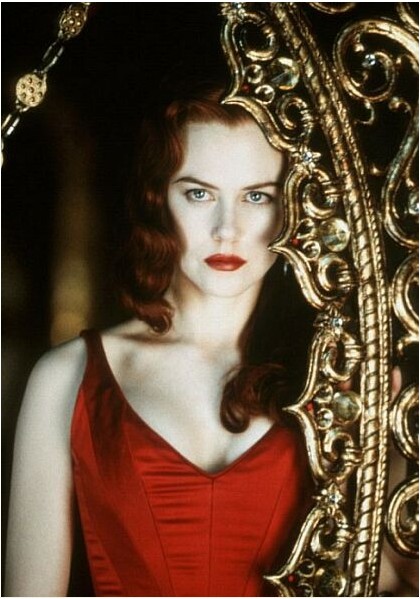
Moulin Rouge! (2001)

Yes, Moulin Rouge, probably one of the more divisive films in recent memory, forcing people to make stands on the grounds of either loving it or hating it. Me? I kinda loved it, but I kinda hated it.

First, the plot. Christian (Ewan McGregor) is a writer who falls in love with the showgirl/hooker Satine, the leading star at the Moulin Rouge in Paris. They work together on turning the Moulin Rouge from a brightly colored den of large women in giant dresses jumping on people and flashing their panties into a theater with which to perform the musical Christian has wrote and in which Satine will star. Unfortunately, their financial backer, The Duke (He's not given a name), also desires Satine.

Ok, let's get this out of the way, Moulin Rouge is large scale musical that features modern songs such as Smells Like Teen Spirit, Diamonds Are a Girl's Best Friend, and Like a Virgin, it also has excellent production values with the costumes and sets covering the screen in bright and vibrant colors. This is where a bit of an issue comes out, it's simply too much. Especially in the first third or first half, where the music video style editing and the cheesy sound effects make it appear like you're watching a live-action cartoon. It's during this part that I almost stopped watching the film, because it was way too hard to watch. I suppose it could be a directorial choice to try and make us feel like Christian, being exposed to the razzle dazzle and craziness of the Paraisian night life, but it came at the expense of the watchability of the film.

Fortunately, the actual plot kicks in and everything mellows down and the film turns into a beautifully crafted and ultimately tragic love story (That's not a spoiler, you find out in the first few minutes of the movie that things don't end well). The musical sequences are brilliantly staged and the songs are used to great effect to compliment what is going on in the plot, and the two lead actors are brilliant (not to mention pretty good singers) in their roles. Christian is hopelessly romantic and slightly naive, slowly maturing as his loves deepens for Satine, and Satine herself is slightly world weary and underneath the glam and sex appeal is a fairly sad and lonely woman.

As a whole, the films ultimately leaves a good taste in my mouth, because the second half is just so good (even though the director relies a bit too much on randomly inserting slow motion), and if you can make it through the first half, then hopefully you'll feel the same way I do. Of course, someone could love the first half and become disappointed that the manic tone of the film tapers off and it settles into a more traditional film, so it's really hard to gauge how people may react to the film.

So just watch it so you can love it or hate it, or get mad at me for suggesting you watch it. But regardless of your view on the film, you can't deny that it's a unique one.

Thursday, August 13, 2009

Overdrawn at the Memory Bank (1983)

Ok, I've done a few classic films, now it's time to do a little trash.

Granted, my fondness for this film has much more to do with the fact that it was mocked on Mystery Science Theater 3000 as opposed to the film being hilariously bad, though it still kinda is.

Raul Julia plays Aram Fingal (easily the greatest named film character of all time), a lowly computer programmer who lives in an Orwellian type future where computers control everything and the obese "Chairman" is in charge. Apparently the Chairman is bad, I don't really know why, as far as I know, we aren't shown anything to suggest that he's evil.

Anyway, Fingal likes to "scroll up Cinemas", in other words, he likes to watch movies instead of working. His favorite happens to be Casablanca, which becomes a mjor part of the film. Once he is caught watching movies, he is forced to be "doppled" as a mandatory vacation in the hopes that it will do him some good. When someone is doppled, their conciousness is placed into an animal, as a sort of vacation. Since he doesn't have the money, Fingal has to become merged with a dirty old baboon named Daisy, but when he has to be taken out of the Dopple do to an emergency, his body is lost, causing him to be uploaded into the Main computer for safekeeping (Why you would put some poor guy in the computer that controls everything is beyond me). There, his romantic interest Apollonia James must monitor him to prevent his identity from being erased. But Fingal decides to incorporate Casablanca into his virtual reality, where Raul Julia also plays Rick and and his sidekick is a creepy Peter Lorre lookalike. But the Chairman enters this reality in the hopes of getting Fingal to stop fiddling with things.

Really, that's the plot, and I've seen the movie at least 10 times and I still don't understand it, because there's this subplot about Apollonia's friend being some sort of spy, though nothing comes out of it, and there's this matter of being "Interfaced" that doesn't make any sense, neither does the final showdown between Fingal and the Chairman.

Plus, the film features a Faux Casablanca set, including a bar called "The Place", not to mention that in order to coax Fingal out of messing around with the computer, Apollonia inserts herself into the reality and gets his attention by descending naked from the sky on a seashell, wearing nothing but some carefully placed foliage, carrying a set of Ten Commandments that say "Thou shalt not mess around with things thout does not understand" or some such nonsense. I'm not making that up.

Worst of all is when Fingal uses his powers in the computer to make a virtual version of frumpy co-worker spend days in bed with him and then makes her disappear when he gets bored with her (Apollonia's response to witnessing Fingal in E-Coitus is to say "Now he's playing around with himself!") And the entire medical system revolves around placing colored fabric circles on the hands of unconscious patients, so a child switching Fingal's circle with another circle basically causes society as a whole to melt down.

Really, it's just an awful movie that doesn't make very much sense, but the production values are so low, and the special effects are so bad, that it's hard not to be entertained.

Any movie that has the line "Electrons don't dance Fingal, they don't make love" needs to be seen.