Friday, July 10, 2009

The Philadelphia Story (1940)

My first Katherine Hepburn (And James Stewart) movie and it's a star-studden affair with a crackling script.

Katherine Hepburn is Tracy Lord, a Philadelphia socialite who called off her marriage with C.K. Dexter Haven (Cary Grant) two years ago and is about to marry the fairly boring George Kittredge (John Howard). However, her wedding is disrupted when Dexter returns, bringing with him two "friends" of Tracy's brother, who are in fact a writer, Macaulay "Mike" Connor (Stewart), and photographer, Elizabeth Imbrie (Ruth Hussey) from Spy magazine, trying to get the scoop on Tracy's wedding. Will she go through with the wedding? If so, who will she end up marrying?

The performances in this film are all fantastic. Hepburn is brilliant as the perfection obsessed socialite who slowly begins to climb down from her ivory tower. She gives Tracy a strength that also reflects some insecurities and fears being held deep inside her that slowly become more and more apparant as the film goes on.

Cary Grant is also in fine form as well. Before the film was made, Grant was given the choice between the two male leads, instead doing with the less showy role of Dexter, and Thank God he did. In the Screwball Kingdom, Grant is king, able to fire off dialogue like a true master, making his verbal sparring with Hepburn crackle with wit and a few dashes of venom.

James Stewart is good as well, playing his character with a bit if intellectual snobbery that allows for Tracy to have someone to relate to. Where Tracy is very critical on anyone who cannot meet her demands for perfection, Mike is a bit if a jaded snob when it comes to the upper class and as the film goes on, we see their views and ideas changing. Stewart actually won the Oscar for this film (though it is generally considered undeserved and that it was a make-up for his loss the previous year). While he isn't given a whole lot to do for the first part of the film, he becomes one of the most entertaining aspects of the film once his character gets drunk halfway through the movie.

Ruth Hussey also deserves mention for her performance as Elizabeth. She's able to see right through everything going on as well as see Mike falling in love with Tracy, but she finds comfort that Tracy is supposed to be married to someone else, thinking it will leave Mike for her. She also gets some of the best lines in the film, standing on the sidelines and offering her imput every so often.

As previously mentioned, the film crackles with wit, and there's a lot of great wordplay and dialogue between all of the characters. It also creates a love triangle that could work on all sides of it, both couples involved make sense and could work.

If I didn't already make it obvious, this is a wonderful film that deserves to be seen.

Wednesday, July 8, 2009

Youtube Help

In honor of my first follower (thank you so much), I have decided to give the poor girl some help. Unable to find any of the films on this list due to where she lives, I'm going to try and find as many of them on Youtube as I can and post links so that anyone remotely interested can give them a look.

Note: I will only be linking to Part 1 of any available films, because the other segments are usually in the Related Videos section anyway.

Key Largo
Whatever Happened to Baby Jane?
BUtterfield 8
Jezebel
Of Human Bondage
She Done Him Wrong
It Happened One Night
Anna Christie
Sunrise
Rain

If you found a film that I missed, or if the entire film is not available, please let me know so I can edit this post.

Also, there are a ton of great Youtube playlists that feature a lot of older films, such as The Apartment or The Little Foxes, so be sure to check those out at well.

If people like having the option of watching the film on-line, I'll start posting links to the films on-line in my reviews (if available).

Also, if you enjoy reading this blog, please become a follower. I'm not begging for validation or anything, I'd just like to get a general idea as to how many people are reading.

Tuesday, July 7, 2009

Key Largo (1948)


Humphrey Bogart, Lauren Bacall, and Lionel Barrymore are held captive in a hotel during a hurricane by Edward G. Robinson in a film that feels like a jumble between The Petrified Forest and Casablanca.

Frank McCloud (Bogart) is a former army officer who makes a visit to Key largo to see the widow (Bacall) and father (Barrymore) of a man who was under him in the war, only to find that their hotel is under the control of Johnny Rocco (Robinson)'s thugs. Things are tense at first, but quickly grow more threatening and dangerous as a hurricane keeps everyone trapped inside, and it falls to Frank to save the day.

The plot of this film plays out as if Rick from Casablanca was dropped into the middle of the diner in The Petrified Forrest. Frank is given the "I stick my neck out for no one" mentality, when we know that deep down inside he's really a hero. That's not necessarily a problem per se, but it does add a lot of predictability to the film since we know that he's going to have saved the day by the end of the film. And Lauren Bacall is totally wasted. As anyone who has seen The Big Sleep can attest to, Bacall is capable of being a great femme fatale, able to add a great deal of intelligence and mystery to her characters, but in this film she's just given a character who is a decent war widow and not much else, in fact, she doesn't even have that big of a part.

The more interesting female character is Gaye Dawn (which sounds like a group of Gay Skinheads), who is Rocco's alcoholic mistress, played brilliantly by Claire Trevor. She isn't afraid to make the character pathetic as she shakes and begs for a drink, even singing for Rocco in the hopes that she will be rewarded with her booze. Robinsoon is good as well, but it's a role he perfected years before.

I'm not trying to say that the film isn't good, because it is. The atmosphere is great and despite what I said, the performances are all top-notch. What's also interesting is the idea of how the world has changed because of people like Rocco and the question is raised if the world will every be the same. It's almost like the main point made in the recent film No Country for Old Men regarding evil in the world.

If you like this film, I really recommend The Petrified Forrest, which has a similar plot and also features Humphrey Bogart, this time as the criminal.

Wednesday, July 1, 2009

Auntie Mame (1958)


Rosalind Russell gives the performance of her life in a film about a woman who was truly ahead of her time.

It's the 1920's and Patrick Dennis (Jan Handzlik and then later played by Roger Smith) is newly orphaned when his father drops dead. As per his will, he is send to live with his Auntie Mame (Rosalind Russell) who was regarded by her brother as a kook. Mame hosts illegal cocktail parties where the guests range from foreign priests to liberal poets to, according to the IMDB boards "obvious" lesbians, living under the motto "Life's a banquet and most poor suckers are starving to death", Mame embraces everything and everyone, changing the motif of her penthouse every few weeks, and dressing in some truly outrageous outfits.

It's hard to go into the plot of the film, because it's VERY episodic, with plot lines introducing themselves and then being resolved 30-40 minutes later. For example, the film begins with Mame trying to keep Patrick in her care after the executor of Patrick's father's will takes him away to boarding school after discovering that Patrick has been enrolled in a liberal co-ed school where the students do not wear clothes, suddenly the plot shifts to Mame struggling through the Great Depression, and so and on so forth culminating in the plotline of a now adult Patrick wanting to marry a very conservative girl from a very bigoted elitist family.

That's part of the main issue with the film, it's length. It's about 2 hours and 20 minutes long, but there are a few scenes that don't really do anything as besides provide for Rosalind Russell to be goofy and whacky. That said, Rosalind Russell owns this movie from start to finish. Mame is larger than life and Rosalind plays it that way, but avoids ever going too far over the top. She hits every emotional note perfectly and creates one of the screens most memorable characters.

The film is witty, entertaining, and actually inspiring, as we hope to emulate Mame and live life to the fullest. But if you're going to see this movie for any reason, it's going to be for Rosalind Russell's performance, which is probably one of the greatest of all time.

Monday, June 29, 2009

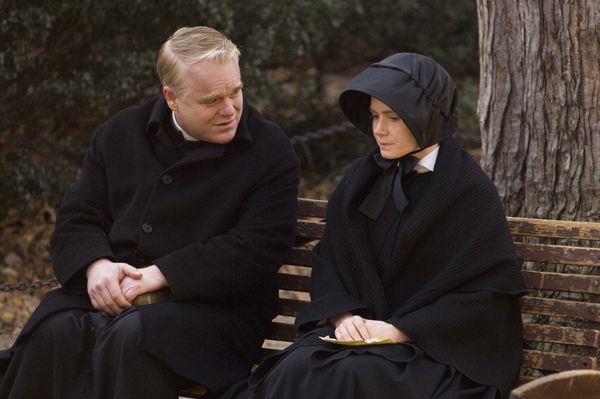
Doubt (2008)


I recently saw Doubt for the third time the other day, and I'm amazed that the film still holds up, in fact, with every view the film feels shorter and shorter.

Meryl Streep plays Sister Aloysius, the stern principle of a Bronx Catholic school in 1964. She is hard-headed, old-fashioned, but fiercely devoted to her students and the other Sisters. Phillip Seymour Hoffman is Father Flynn, the new priest who has more progressive ideas, such as making the students feel like part of a family in addition to adding secular Christmas songs to the school Christmas show. When History teacher Sister James (Amy Adams) observes some odd behavior on both Father Flynn's part as well as Donald Miller, the school's first and only black student, she turns to Sister Aloysius with her suspicions and sets off a chain of events that call into question faith and certainty as Sister Aloysius sets out to expose Father Flynn without a shred of evidence.

First off, the mainy reason to see Doubt is for the high level of acting that you will see in this film. Meryl Streep is fantastic as the forceful and occasionally funny nun who is devoted to seeing a monster ejected from her school. Streep gives us a sense of fierce maternal instinct for her students as well as someone who has suffered hardships in the past and is now an excellent judge of people. Amy Adams is also great as the innocent Sister racked with guilt over bringing to light an indescretion that she believes never happened. Viola Davis (who has not been mentioned yet) is insanely powerful in her brief appearance as Donald Miller's mother. She is a woman who is simply trying to keep her life together between a son who has a few secrets of his own and her abusive husband. And when questioned by Sister Aloysius, she is able to drop the mask and show the deep fear, hurt, and maternal love bubbling underneath.

But the standout of the film has to be Phillip Seymour Hoffman, who has the difficult task of playing a totally ambiguous character. He has to straddle the line between guilt and innocence and he never tips his hand towards either, instead he plays the character in a way where every emotion could be seen as a confession or an absolution.

The film itself is almost like a mystery without a grand denoument. Which works in it's favor, because the film is so ambiguous as to what is and isn't happening, that it could have seriously hurt the film to go in one way or another. Plus, it allows for some great discussion, after seeing it last, my brother and my three cousins spent about an hour talking about out own theories as to what happened.

The film can be a bit heavy handed at times though, it constantly relies upon wind metaphors, with references made about the strengthening wind throughout the film, there is also a lot of dutch angles used in the film, which may turn some people off. It's also a very dialogue heavy movie, with no real action scenes which could turn some people off.

But if you enjoy smartly written, brilliantly acted films that can actually leave you discussing it for hours, you will love Doubt, like I did the first time, the second time, and the third time I watched it.

Oh, before you watch it, please keep in mind that you probably shouldn't take the last line of the film 100% literally. I know a few people who have stated that it ruined the movie because they didn't really look beyond what it could potentially mean, so please keep an open mind.

Friday, June 26, 2009

Dinner at Eight (1933)


An All-Star cast save this film which felt like only half of a movie.

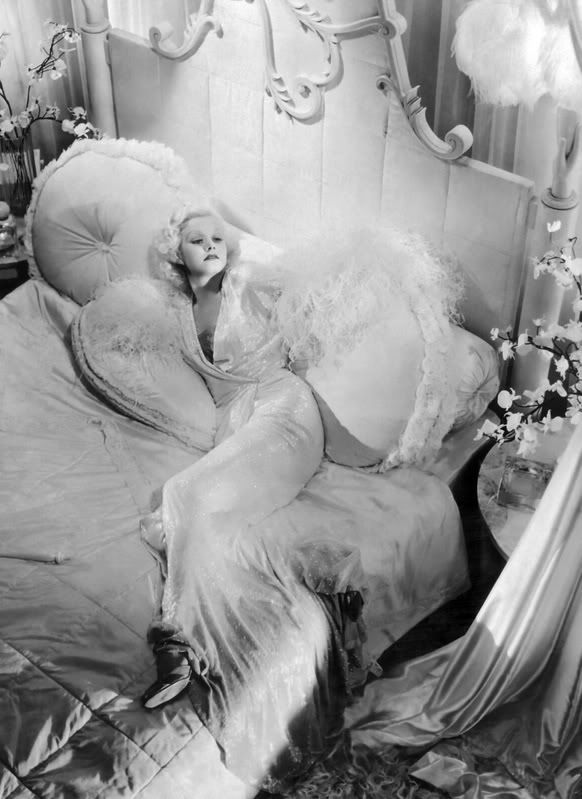
Millicent Jordan (Billie Burke) is hosting a dinner party as part of a social coup, she has secured a wealthy British couple as her guests of honor. The film basically follows the story of her guests as they prepare for the big event. Some of the guests include Carlotta Vance (Marie Dressler), a washed up actress who is the former lover of Millicent's husband Oliver (Lionel Barrymore), Dan Packard (Wallace Beery) who is a mining tycoon who is planning on using dirty business dealings to take over Oliver's shipping company, there is also Kitty (Jean Harlow), Dan's brassy wife who is carrying on an affair with another dinner guest, Dr. Wayne Talbot. There is also Larry Renault (John Barrymore), another washed up actor who is having an affair with Millicent's engaged daughter.

The main problem with the film is that it focuses on all of the tangled relationships of the guests, but the film actually only shows the dinner party for about 10 minutes at the end. It feels like all build-up with no payoff, because we have people who are having affairs who are going to be attending with their spouses, but it doesn't really amount to anything.

Luckily, the cast is uniformly excellent, with Jean Harlow stealing the show as the brash and spoiled Kitty, but Billie Burke is also great as a woman obsessed with planning her dinner party, only for it to slowly fall apart around her. John Barrymore also deserves from credit for the most dramatic role in this comedy as a man who slowly begins to realize that he is not as important or talented as he thought he once was.

I don't know if it's actually the fault of the film or my own expectations that led to my main issue with this movie. If I hadn't expected the film to primarily focus on a disasterous dinner party (which most summaries will say about the film), I probably would have enjoyed it more than I do, but I was just anticipating all of these characters finally coming together and watching the sparks fly. But if you walk into the film without any such expectations then that in combination with the stellar cast make this a fun little film worth watching.

Friday, June 19, 2009

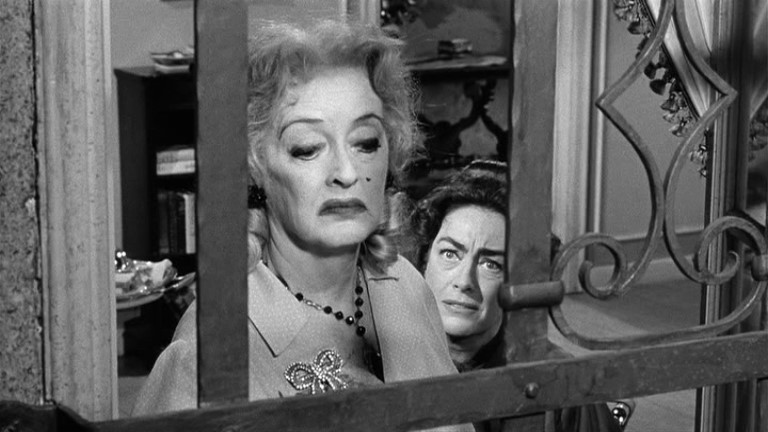
Whatever Happened to Baby Jane (1962)

Bette Davis and Joan Crawford are brought together for what should be considered the Holy Grail for fans of Classic Hollywood Catfights and B*tchery.

Bette Davis plays Baby Jane Hudson, a former child star who quickly lost her luster as she grew older. Unfortunately for her, her sister Blanche (Joan Crawford)'s career took off and she became a movie star. Unfortunately for Blanche, booze and jealousy combined in a car accident that left her in a wheelchair, leaving her in the care of her sister who begins to grow more and more unstable.

Let me get this out of the way and say that both leads are fantastic, but this really is Bette Davis' show. Blanche has to be the sympathetic character, so she remains much more one note than Jane, who gets to go from bitter alcoholic to going through a twisted second childhood. Davis hits all of the emotional beats perfectly in a role that could have easily been played to scenery-chewing camp, but Bette Davis gives Jane a sort of internal turmoil and humanity that could have otherwise been lacking.

In fact, the whole movie somewhat tricks you, it starts out as you would expect, with Jane mocking and abusing Blanche in a sort of dark-comedy, but it slowly fades away as Jane begins becoming more and more unstable and what we're left with is two wounded individuals who have hurt each other and have made some horrible mistakes.

The film is primarily about the two leads, with only two prominent secondary characters. Elvira (
Maidie Norman), the housekeeper who is Blanche's only ally in the house, and Edwin (Victor Buono), the pianist Jane hires to accompany her when she begins planning to resurrect her act. Buono actually received an Oscar nomination, but to be honest, I'm baffled by it. It's not that he does a horrible job, but his character is basically just a slimeball loser who lives with his mother.

This is a film that deserved to be seen. It's a very dark little movie, but you have two of classic cinema's biggest titans (who hated eachother) together in one film and delivering great performances. There's not really a whole lot to hate.