Wednesday, August 12, 2009

I'm No Angel (1933)


Yes, another Mae West movie, which guarantees entertainment. I know I've said it before, but Mae West's movie are endlessly entertaining. They aren't necessarily the best movies, but they don't need to be, it's essentially Mae West walking around being a sassy whore.

Mae West plays Tira, a circus performer who, of course, is the darling of all the men who visit the circus. When she needs some money, she decides to perform a risky new act involving tons of lions. The sequence itself is filmed pretty poorly, but it's entertaining in how bad it is. Tira becomes even more famous and begins to flirt with the various rich men that are enchanted by her. Until she meets Jack Clayton (Cary Grant), the love of her life, but her sordid past catches up to her and she must fight to keep her man.

Really, there's not much else to say, since the best part of the movie is Mae West wearing insane looking outfits and tossing out zingers, much like She Done Him Wrong. Which is probably the strength of Mae West's movie, you know exactly what's going to happen, yet you're entertained the entire time, because she doesn't try to make her movies anything more than they are. Like She Done Him Wrong, this film is very short, it's not even a full 90 minutes, which means it never wears out its welcome.

It's easy to recommend this movie, simply because it's pure entertainment, even when it gets into melodrama and cheese, it's still fun because it's Mae West, the queen of Pre-Code Comedy. It's especially fun to watch it (And any other Mae West movie) with other people, because it's just a big cheesy, sassy mess that is easy to enjoy.

Tuesday, August 11, 2009

The Big Sleep (1946)


If you've noticed a pattern from any of my entries, it should probably be that I end to focus more on the female stars of the past as opposed to male. I'm not entirely sure why, but it led to my massive disappointment in the film Key Largo, which can read about in a past entry, when Lauren Bacall was simply placed in the role of "Decent War Widow" who didn't do much else but look frightened. Well, in The Big Sleep, she used to her best as a fast-talking, mysterious, and intelligent woman who may or may not be a killer.

Humprey Bogart is Phillip Marlowe, a Las Angeles private eye whose new client, General Sternwood (Charles Waldron) asks him to resolve some gambling debts of his impulsive, flighty daughter Carmen (Martha Vickers). Upon leaving, he is approached by Sternwood's recently divorced older daughter Vivian (Lauren Bacall) who suggests that there may be more to the case than some simple gambling debts. And as expected, Marlowe is submerged in a world of murder, lies, and crime, where the woman he's falling for may be the woman he's after.

The plot itself is a bit convoluted, in fact, there's one murder than never is solved, which apparently the author of the book on which the film is based was unaware of. But the plot is really only a vehicle for Bogart and Bacall to engage in the fast-paced, witty banter for which the film noir is famous. And both leads are fantastic, with Bogart nailing the persona he could play sowell, that if a morally ambiguous tough guy and Bacall adding wit, intelligent, and mystery to a quintessential femme fatale.

Much as been made of the Bogart/Bacall combination that started with To Have and Have Not, resulted in their marriage and lasted until Bogart's death, and resulted in 4 movies. I've only seen 2, but this film probably exemplifies what made the pairing so electric better than Key Largo. Bacall was essentially the perfect match for Bogart, able to be as cunning as he was, as witty as he was, plus she had beauty and an ability to keep Marlowe and the audience guessing as to what she was thinking.

The film has become a classic, and for good reason, the script is insanely clever, with some of the best dialogue put on film being spoken by some of the best actors put in film. The plot is incredibly complex, which will keep people guessing as to which person is really who they say there are and if they really did what they say they did. A true classic of the genre.

Sunday, August 9, 2009

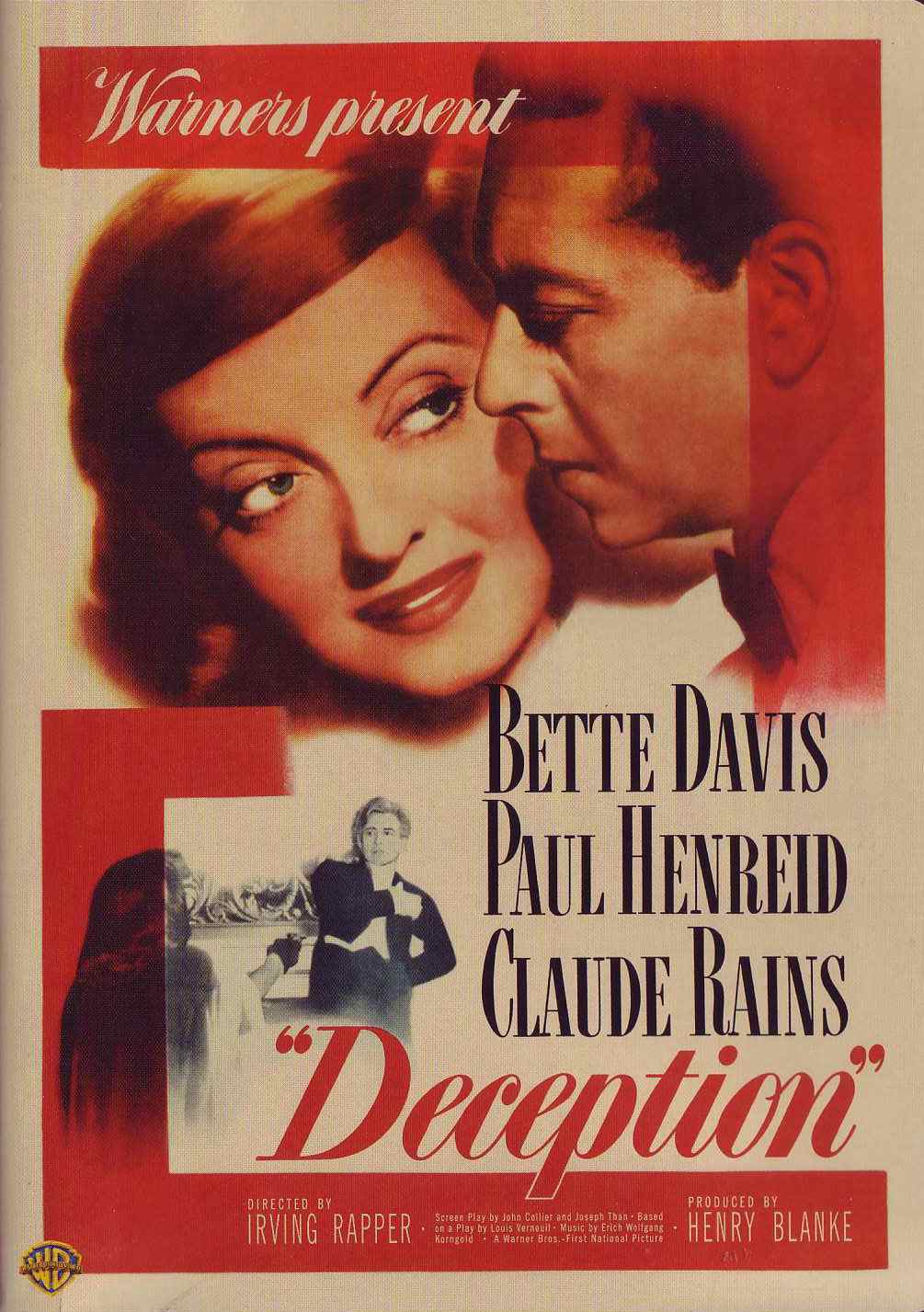
Deception (1946)


Ok, it's been a while since I've actually given a write-up to a Bette Davis movie, and since yesterday was Bette Davis say on TCM's "Summer Under the Stars" I figured I would write about one of her lesser-known movies.

Bette Davis is Christine, a pianist who believed for many years that her long-lost lover cellist Karel Novak (Paul Henreid) was killed in the war. That is, until she encounters him during a concert and the two resume their romance. However, during Karel's absence, she had taken a new lover, the famed composer Alexander Hollenius (Claude Rains), a fact that she hopes to keep from the incredibly jealous Karel, even if she has to resort to desperate means to do it.

Karel is a jealous type, all right, which is actually the movie's downfall. Bette Davis and Claude Rains are on a high level here, especially Rains who revels in the part of the brilliant composer toying with Christine and Karel's romance. But the main problem is that Karel is such a jealous douche that it's hard to find yourself becoming tense or worried when Christine's affair comes close to being revealed. I mean, when he sees her beautifully furnished apartment when they first reunite, he tries to STRANGLE her, believing her to have taken up with another man, and later he slaps a glass out of her hand. I mean, I dunno what your views on monogamy are, but I would think that if you were thought to be dead for years, it would be ok for your significant other to find someone else, especially when they immediately come back to you. So it's hard to actually care for the character that would supposedly be destroyed by the revelation that the film hinges upon.

Luckily, Bette Davis makes us care for her character, so there is some investment in whether or not her relationship is revealed, but it's purely for her sake, not Karel's. But if there's any reason to see the movie, it's Claude Raines, who plays such an interesting character. He loves Christine, yet he's jealous enough to where he sets out to destroy her and her new husband and he does it all with a smile on his face and cheeky remark on his lips.

The film itself isn't horrible, it's just hard to invest yourself in the main romance, but aside from that, it's not a bad movie. But if you happen to like the cast from the film, check out Now, Voyager which features the same actors and is MUCH more enjoyable.

Thursday, August 6, 2009

Born Yesterday (1950)


Judy Holliday is the fiance of a corrupt businessman who undergoes tutoring to "smarten her up" and in the process discovers what she truly wants out out of life.

Ok, that sounds very Lifetime-ish, which the film is not. It's not nearly as melodramatic as that description would suggest, but it still applies to the film, so there's not much I can do about it.

Judy Holliday is Billie, a slightly dim former chorus girl who is now the stay-at-home fiance of crooked businessman Harry Brock (Broderick Crawford) who has made a big movie to Washington in the hopes of persuading some crooked politicians into passing laws and bills that benefit him and his business. Since he's going to be entertaining the wealthy and powerful, Harry hires Paul Verrall (William Holden) a newspaper writer to tutor Billie and make her presentable. From the beginning, Paul and Billie have an attraction to each other, and through Paul's tutoring Billie becomes more idealistic and begins to question the way that she and Harry lives their lives.

It is an understatement to say that Judy Holliday is 100%, totally, absolutely pitch-perfect in this film, nailing every single frame that she's on. Her character may originally appear to be a simple dumb blond, but Holliday has to be charming, full of vitality, slightly stupid but still give a hint that she possesses some intelligence, and then make a very subtle change to her character. Billie never becomes a genius, quoting Shakespeare and spouting scientific theories. The main change she undergoes is that she begins to latch onto a few key ideals that begin to shape the way she sees the world. So she has to change enough to forward the plot, but keep it subtle enough to wear it remains believable and Holliday pulls it off masterfully.

I know she's gotten a lot of flack over the years for winning against Bette Davis and Anne Baxter for All About Eve and Gloria Swanson in Sunset Boulevard, but I don't have any complaints after seeing this film. She takes a character that may seem like a movie staple and adds depth and charisma to make her entirely endearing.

The rest of the cast is suitable, but they aren't given a great deal to do. Harry yells all the time and is basically an ignorant bully, and Paul is an idealistic writer and neither character pushes beyond that. It makes sense, though, because Billie undergoes the primary change of the film, and both men serve as opposite ends of the spectrum that we see Billy travel upon, becoming less like Harry and more like Paul.

The script is sharp and funny and as I said, Judy Holliday is astounding in the role and make the film worth seeing just for her, but luckily the rest of the film is great too. It's definately one to watch.

Wednesday, August 5, 2009

Man's Castle (1933)

Spencer Tracy and Loretta Young play a Depression Era couple who have to deal with poverty as well as the unique dynamics of their own relationships.

Tracy plays Bill, a poverty-stricken man who encounters Trina, who is also dealing with the Great Depression. Whereas Bill is able to somehow always able to find food, Trina is starving on the streets, refusing to take the easy route and prostitute herself. Upon seeing Trina jealously eying the popcorn that he is throwing to some pigeons, Bill takes her to dinner (which he can't afford) and then invites her to live with him in the shantytown in which he lives.

There, through a serious of vignettes, we see the relationship develop, as well as the issues plaguing the relationship. Bill is a somewhat childish man, who never sticks around for very long, but certain events occur that could keep him nailed down in one place, and he struggles with his urges to leave as well as his growing love for Trina.

What makes the film interesting is the dynamics between the two. It's very easy to see Trina as the poor downtrodden woman who only wishes to become a good wife for the man who saved her life, but she's probably the most stable and mature in the relationship. She understands who Bill is, and accepts it, giving him the independence that he so thrives on. Bill, however, seems to keep Trina at arm's length, trying to leave room open for the departure he feels is inevitable, but we get to see him change, particularly in a series of money-making methods to buy a new stove for Trina. The brilliant thing about the stove is that it requires monthly payments, so it comes to represent a commitment, one that Bill seems willing to make for Trina's happiness.

It goes without saying that the acting is top notch, with each actor fully embodying their character and giving in rich and subtle performances. Loretta Young is bright and happy as Trina, which serves as a brilliant counterpoint to Spencer Tracy's aloof Bill, who acts almost like a bird in a cage for most the film, hoping to somehow get free.

The film, which was directed by Frank Borzage, almost has the feeling of a bizarre fairytale. When we first see the shantytown in which Bill lives, it's almost idealized, like some sort of Fairy Land, due to the lighting and mist. Which is odd, because the film has more "real life" issues than a lot of older films, primarily because it was pre-code film. Just the fact that the film focuses on a unmarried couple who live together sets it apart from a lot of other films.

The film is really good, and it's probably hard to find, since it's quite obscure. I'll post a link to the first part of the movie on youtube at the bottom of this entry, and I hope you actually take a chance to watch it, because it's a great little movie that hasn't really received the attention is probably deserves.

Part 1

Monday, August 3, 2009

The Lady Eve (1941)

Barbara Stanwyck is a tough cardsnipe who tries to take naive rich boy Hentry Fonda for a con, only to fall in love with him.

Barbara Stanwyck is Jean Harrington, a cardsnipe who travels from boat to boat with her father setting wealthy men up in card games to take them for all they're worth. So when Charlie Pike, son of a wealthy Ale maker boards their ship, Jean sets about romancing the poor fool and robbing him blind. unfortunately she falls in love with him, and to make matters worse, Charlie finds out what she is, lies and states that he was on to her the entire time and was only playing her for a sap and they part ways on the boat, leaving Jean broken-hearted and full of hate.

She plans to get her revenge, however, but showing up at Charlie's father's house as The lady Eve, winning Charlie over and then breaking his heart just like he broke hers. But, given that this is a romantic comedy, things don't necessarily work out that way.

Let's get this out of the way, Barbara Stanwyck is fantastic in this movie, especially when you consider that she's really only her "true" self a few times, and most of the time she's pretending to be someone else. She makes Jean tough, but still vulnerable, and she gives her an intelligence that makes her a believable card snipe and smart enough to realize that being in love with a man you've only known for a few days is pretty silly.

Henry Fonda is good as well. Making his character appear to be clumsy, naive and spoiled, but never to the point where he's unlikable. He has the task of making it appear believable that he could fall in love with the same woman twice, and it really works.

If there's any real fault with the film, it's that the comedy aspect of it is very light. I didn't find the film particularly humorous, but I still enjoyed the lightheartedness of it, as well as the script and the acting.

The film itself feels very brisk, despite being an hour and 40 minutes long, it seemed to fly by, which is great because it never seems to wear out its welcome.

While I wish the film would have been a bit funnier, the acting more than makes up for it, particularly on the part of Barbara Stanwyck. It may stretch your suspension of disbelief (though, the film plays on that by having on character constantly insist that Jean and Eve are the "same dame"), but it's a good film that's become a "must-see" when it comes to screwball comedies.

Saturday, August 1, 2009

Who's Afraid of Virginia Woolf? (1966)

One of my favorites movies of all-time, featuring a brilliant cast, a great script, and an insane amount of venom and poison.

Elizabeth Taylor and Richard Burton are George and Martha, a middle aged married couple who spend their days insulting each other, insulting others, and engaging in various flights of fancy. George is a history professor at a college where Martha's father is the president. One night, after a part welcoming a new instructor, the couple have the new teacher, Nick (George Segal) and his wife, Honey (Sandy Dennis) over for a nightcap. What follows is a descent into the twisted relationship between George and Martha and the cruel games they play with others and themselves.

The acting in the film is phenomenal. Elizabeth Taylor (who at the time was too young to play a middle aged woman) gained a significant amount of weight to play a character whom she inhabits with great zeal and nastiness. Martha is loud, obnoxious, rude, nasty, and is willing to do whatever she can to break her husband's spirit, even if they happen to be entertaining guests at the time. But Taylor never does it to a point where it becomes unbearable to watch, instead, she fuses Martha with a great bit of humor that allows for several funny moments in the film, even though she happens to be digging into her husband.

Richard Burton is great here as well, playing a man who hasn't amounted to much in life, who speaks in an odd, roundabout manner, possibly because he seems to constantly drift in and out of some sort of daydream. While he tries to go toe-to-toe with Martha, he comes across as much weaker, usually letting her dig into him over and over. Burton gives George as great deal of weariness and sadness that never becomes too overbearing.

George Segall, unfortunately, seems to have the least to work with. His character, Nick, comes across as just a normal guy who happens to be stuck with a pair of old bitter people. But, this is probably intentional, because he has to serve as the main reaction to the anger and venom we see unleashed between the two, and they become a reminder of what he and his wife may eventually turn into one day.

Last but not least is Sandy Duncan as Honey. Duncan was the second Oscar winner for this film (Taylor also won Best Actress) and it's totally deserved. Honey is someone who wants to be the perfect housewife, so she deals with the craziness of the night by laughing it off, and by taking a drink. And another, and another, and another, until she's dancing around the room. Duncan has to make the more significant transition in the film, going from a seemingly happy housewife to a sobbing, drunk mess who discovers a few things about her marriage she never wanted to hear and she plays it off perfectly.

The script is insanely good, able to be both layered and entertaining. George and Martha's bickering originally starts as funny, only to descend into nastiness and anger, it also contains a lot of subtext about what is and isn't true about what George and Martha say about themselves. It's just fantastic.

I cannot recommend this movie enough, it's easily of on my top movies ever, and for those who don't mind "movies where they just talk" with a very small cast (only 4 characters), you're in for a brilliant movie.