Thursday, September 17, 2009

Old Acquaintance (1943)

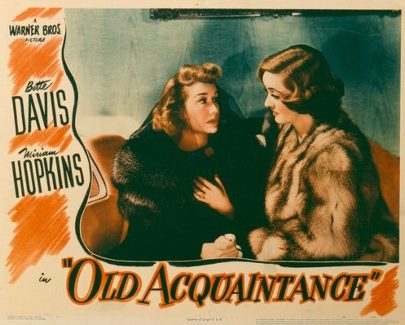
Bette Davis and (the one woman she admitted to hating) Miriam Hopkins star together in this wonderful soap about friends who kinda hate each other.

Bette Davis is Kit Marlowe, an unmarried independent author who has written a critical hit of a book that is unfortunately, not selling very well. She is "friends" with Millie Drake (Miriam Hopkins), an over-the-top attention whore of a shrew who only is able to retain her friendship with Kit because Kit feels a deep sense of responsibility to her because of their childhood together. It doesn't help that she is in love with Millie's husband, who also feels the same way about Kit, and further adding to the friction is when Millie decides to become an author as well, writing trashy romances that make millions. The film follows their friendship as well as their fights and squabbles.

What works about the film is that you never really buy Kit and Millie as friends, Kit is simply too smart and too low-key to enjoy being in the company of the hysterical Millie and the film brilliantly adds conflict after conflict to eventually force the two to have it out. Plus, it's very soapy, with catfights and forbidden love and the stuff that classic films excelled at with class.

As to be expected, the two leads are great. Bette Davis is often cited as being a Hollywood "bitch" but she was much more versatile than people think and the strong, independent, yet still vulnerable woman is a role in which she excelled. Kit is intelligent, kind, warm, and strong, but clinging to a foolish sense of duty to Millie as opposed to following her own feelings. Miriam Hopkins has a license to be overly dramatic in this film, and she takes full advantage of it, not really making an effort to make Millie very likable, instead being as shrill as possible. And as I said, their friction is believable, in part because the two actresses publicly admitted to hating each other, which is odd since they made 2 films together (The other film, The Old Maid doesn't utilize their feelings towards each other in the way that this film does).
This seems to be (to me at least), a lesser known Bette Davis film, which is a bit sad, because it is one of her better films. Granted, at the end of the day, it's a big soap opera and the strong woman is a character that Bette Davis has played countless times before, so this is not new territory for her. But the film still succeeds at offering a good soap with good acting and some good bit of "frenemy" action before that became an actual term.

So watch it, if you can.

Tuesday, September 15, 2009

Soultaker (1990)

I usually try to make entries based upon my Netflix viewings, since that way the films are fresh in my mind. Well, after Peyton Place, I decided to indulge myself and get a Mystery Science Theater 3000 Episode. Since I haven't been the best blogger in the world, what with school starting, I figured I would go ahead and take the opportunity to comment on this horrible little film, also known as Soultaker.

The film revolves around 4 teens who are killed in a car accident, the impact throwing their souls from their bodies, leaving their bodies comatose and their souls on the run from The Soultaker (Joe Estevez), a grim reaper type individual who harvests souls by placing little black rings against their bodies.

Things are complicated when The Soultaker realizes that Natalie (one of the teens) is either a reincarnated version of the woman he loved (and eventually killed for cheating on him) or she just happens to look exactly like her.

This is where Soultaker gets most of its "so bad it's good" moments, from he fact that Vivian Schilling, who plays Natalie also wrote the script, which seems like an effort to boost her self esteem. The entire film is basically about how beautiful she is and how she had two men madly in love with her, even though she looks like Tonya Harding. There's even a scene where she is undressing in slow-motion while her "mother" (The Soultaker in disguise) ogles her teenage body, it's really gross.

There's also an odd attempt at adding a Romeo/Juliet type aspect to the relationship between Natalie and her boyfriend Zach, making her upper class and making him lower class, but all it ends up doing is adding a bizarre homoerotic subtext to the story. You see, Zach's best friend, whose name I cannot remember, is totally against the relationship, because of the class difference. But he's a little bit too passionate about it, and he is the ultimate reason the teens die, because he's driving the car that crashes and it only crashes because he decides to go way over the speed limit because of his issues with the relationship (I'm not sure how that resolves anything, but there you go.) It's very odd and it seems like Zach's BFF has more interest than just being friends with him.

Plus, the film doesn't make a whole lot of sense. Apparently if you murder someone, you must become a Soultaker, which Zach's BFF eventually becomes, even though the crash was caused by THE Soultaker stepping in front of the car and making him swerve. Plus, according to this film, Heaven exists in an upper story of the local hospital, and if there is a heaven, where all the souls go, then how is Natalie the reincarnated version of this guy's long-lost love?

But really, it's just a horrible movie, the acting's horrible, the writing is horrible, but hopefully that poor unattractive girl got a bit of self-esteem out of the whole thing.

Sunday, September 13, 2009

12 Angry Men (1957)

I apologize for the inactivity lately, since school has started and my dogs have been sick, my time's been spent elsewhere. But I return, bearing gifts, in particular an entry for the classic 12 Angry Men.

For those not familiar with the film, it follows 12 All-male, All-white jurors in a single room in a courthouse, charged with the determining the fate of a young Latino who is accused of murdering his father. When they cast their initial vote, all are prepared to give a sentence of Guilty, except for one juror, Juror #8 (Henry Fonda).

What follows is a re-examination of the evidence that pulls into question if the jurors can say with absolute certainty that the young man is guilty beyond a reasonable doubt.

What makes the film interesting is how diverse these men are. Since they are all of the same ethnicity and gender, you can get to the real issues that may effect jury votes. For example, one of the juror's has tickets to a sporting event, and is basically willing to vote any way that will end the trial as soon as possible, while another is hopelessly bigoted against minorities, talking about "those people" and "their kind".

It's hard to talk about the performances, since the cast is quite large and it's very much an ensemble piece. But you can't really talk about 12 Angry Men without talking about Henry Fonda and Lee J. Cobb.

Henry Fonda proves that he is probably the greatest "Everyman" actor with this film, as he gives Juror #8 nothing more than intelligence and a belief in justice. Other than that, he's a typical man, we know nothing of his past except that he's an architect. But we don't need to know, because Henry Fonda spells out his history with his own face, showing a man who believes in being fair and taking pull responsibility of the duty he has been given as a juror.

Lee J. Cobb serves as the "villain" of the film, he is a man who has a personal vendetta against the accused, because of his own broken relationship with his son, he sets out to act as executioner against the generation that has broken his heart. He is older and less educated than Juror #8 and he makes his decision based on emotion and from the get-go, we know that he is the one Juror that will be the hardest to convince, setting up for a interesting battle of the wills between the two actors.

Praise must be given to director Sidney Lumet who never makes us feel trapped or claustrophobic. Since the film, for the most part, takes place entirely in the jury room, it's up to the director to keep things interesting, visually. And Lumet pulls it off effortlessly, keeping the camera focused on the brilliant acting and dialogue and never letting us become aware that the action doesn't shift locations.

But really, you don't need me to tell you to see this movie, it's an American classic that speaks of the issues that the justice system faces as well as being a showcase for some truly great acting.

Wednesday, September 9, 2009

Peyton Place (1957)

Well, I finally watched my Netflix movie, and boy was it worth it. Peyton Place may be one of the biggest soap operas to ever hit theaters.

The film "stars" (Though there doesn't seem to be one actual main character) Lana Turner as Constance McKenzie, a single mother who moved back to her childhood home of Peyton Place after her husband died, leaving her with her daughter Allison (Diane Barsi), a senior in High School. She keeps a firm hold on Allison, terrified that she may commit some sort of scandal, despite Allison being a very good-natures and intelligent young woman who wishes to become a writer.

Allison herself is having a budding romance with Norman Page (Russ Tamblyn), a shy young boy who lives with his oppressive mother, causing him to be totally inept when it comes to girls.

There's also a plot about Allison's friend Selena (Hope Lange) who lives in a small shack with her mother and stepfather, who has to deal with her step father becoming more and more abusive towards her. In addition, there's a story of a classmate of Allison's who is in love with the town slut, but is torn between his whore and his wealthy father who forbids the relationship.

It all takes place in (obviously) Peyton Place, a town which is sexually repressed and filled with gossip hungry people. It was Mad Men before Mad Men, dwelling on the themes of appearance anf perception.

In case you didn't get the impression already, this movie has a lot of plot. So much so that it feels like you're watching a TV series, and this is going to turn some people off. Well, it's also very long, over 2 and a half hours, and very episodic. There will be chunks of the film that are entirely devoted to side character like Selena, so some could view the film as unfocused.

But the film works because the level of acting is so high. Lana Turner, Hope Lange, and Diane Varsi are all brilliant as the three "main" women. Lana Turner keeps her character very reined in, very cool and repressed but she begins to slowly open up as the film progresses (this is actually symbolized by her hair, which is kept in a tight up-do for most of the movie and begins to slowly become looser). Hope Lange breaks your heart as Selena, who probably has to deal with more than any other character in the film, and she pulls it off with strength, never making her character a victim. And Diane Varsi adds intelligence and warmth to a character who sees Peyton Place for what it really is and wishes to expose it in her writings.

The film itself is quite brave, as it deals with the whole "Suburban Repression" topic that was considered to be untapped until the recent film American Beauty. And it deals with it all in an entertaining and soapy way, serving as an indictment of those who seek to ruin someone's reputation as well as serving as a wake-up call to those who value their reputations more than their own happiness.

Plus, as I said, the film is pure soap opera, but it has something behind it, something worth saying which elevates it above pure pulp trash. It's a well-crafted film and one that I heartily recommend.

Monday, September 7, 2009

The Star (1952)


Bette Davis stars in a film that is apparently supposed to be a thinly veiled portrait of Joan Crawford. That alone makes this movie a must-see.

Well, not really. Bette Davis plays Margaret Eliot, a now has-been actress who is struggling to keep afloat, but through her renewed romance with former co-star Jim Johannson (Sterling Hayden), she may realize that love is more important than fame.

The film itself is one big cheese-fest, with Bette Davis showing why she may be one of the greatest actresses who ever lived. She may be over the top, but she is insanely entertaining here. I mean, this film has a scene where (I kid you not) Bette Davis throws her mooching sister and brother-in-law out of her house then grabs her Oscar and says "Come on Oscar, let's you and me get drunk!" only to cut to Bette Davis driving around the Hollywood hills with her Oscar propped up on the dashboard and a bottle of booze in her hand.

It may be the greatest scene in the history of film.

Ok, to be serious for a moment. Bette Davis is the only reason to see this movie. It's a corny, soapy film that Davis elevates by actually giving a good performance. Granted, it's over-the-top, but it can get a bit of a pass because she's an actress, and generally people in the arts can be over-the-top (or so says any movie review in which someone is playing an actor/dancer/artist). But aside from that, the film is pretty dull. Her romance with Jim lacks any sort of spark and Sterling Hayden (I keep expecting to write Sterling-Cooper) is wooden in a role that's not particularly fleshed out. The actual plot is pretty shallow too, and only really entertains on a pure campiness level, like when Margaret gets a role in a film as a frump, but she tries to sex it up using her hair, make-up, and costume only to watch the dailies and fall screaming to the floor.

To put it plainly, this is a film you could easily skip, unless maybe you are hardcore Bette Davis fan (like I am) and you're interested in seeing her Oscar nominated performance. But other than that, unless what I just described sounds like your idea of a good film, it's a pass. Campy entertainment and not much else.

Sunday, September 6, 2009

Wait Until Dark (1967)

Audrey Hepburn is a blind woman being terrorized by Alan Arkin in an attempt to get a drug-filled doll from her apartment.

Really, do I need to say anything else? But since I've been neglecting you, my poor readers, I suppose I'll try to flesh out as to why you should see this movie.

First of all, let's get to the plot. Audrey Hepburn is Susy, a woman was recently blinded and still learning how to live in a world she cannot see. One day, he husband brings home a doll that a woman asked him to hold for her at an Airport, claiming that she didn't want her daughter to see it and ruin a birthday surprise. In reality, she was hoping to prevent her partner Roat (Alan Arkin) from getting the doll, which is filled with heroin.

So the doll ends up in Susy's apartment, and one a day where her husband is working, Roat and two associates create a story about Susy's husband Sam being involved in a murder and that this doll is evidence that could implicate him, hoping Susy will hand it over since they can't seem to find it. Unfortunately for them, Susy begins to grow wise to their plan, setting up a confrontation between the murderous criminal and a blind woman adjusting to life.

One issue with the plot, it's a bit ridiculous. In fact, Susy seems to never lock her door, allowing for Roat and his henchmen to walk in and out without Susy noticing. This may bother some people, and I can totally understand that, though if you consider that for the majority of the film, one of Roat's henchmen pretends to be an old friend of Sam's, it makes sense that she would leave the door open for him.

Now the acting. Audrey Hepburn is magnificent in the role of Susy. She creates a character who is hanicapped, but not useless. She's realistically limited because of her blindness, but it's not to the point where she has to rely on other people to bail her out, she can hold her own. And Hepburn adds gallons of likability to the character, making Susy a smart kind woman who is able to catch on to what's going on, hitting every emotional note perfectly as she has to run the gamut from being angry, terrified, suspicious and happy.

Alan Arkin is good as well, effectively portraying a character that is essentially a killer Beatnik. He's menacing as Roat, and he adds a twisted pleasure out of his dirty dealings, elevating him from a simple criminal to a psychopath.

And the film totally works. Audrey Hepburn makes you care about Susy, which makes it all the more gripping as we see the noose tighten around her neck as she unravels the lies around her, forcing Roat and his men to take action, making for a very tense viewing experience.

I can't recommend this movie enough. As I said, it may turn some people off with what they may feel to be the "Idiot Plot", but I happen to love this film.

Saturday, September 5, 2009

Atonement (2007)

Sorry for the lack of updates, I've been busy with school and some dog issues.

But anyway, I'm back (Hopefully), and I think I'll start with a film I recently watched, and it's also a film that I disagree with the majority when it comes to this film.

As some of you may know, Atonement was nominated for a slew of Oscars, including Best Picture, and it tells the story of Cecilia and Robbie, two young adults who fall in love. Robbie is the son of Cecilia's family housekeeper and is attending the same college as Cecilia (on Cecilia's father's dime). Their romance is cut short, however when Cecilia's younger, would-be-writer sister Briony (Saoirse Ronan, then later Romola Garai, and then Vanessa Redgrave) accuses Robbie of a crime he did not commit, sending him to prison, and later into World War II.

The film itself is beautifully made, with great costumes, and sets and cinematography, but the plot falls flat. Not because it is poorly written or not well-acted (in fact, the cast is universally good), it's that the romance between the two characters is so rushed that I never bought into it and the tragedy of the film was lost. Maybe I have an issue when it comes to romances, but when it comes to "Here are two characters, now care about their relationship" type scenarios, I usually find myself indifferent. The film is still easy to watch, and it's not offensively bad, but it's a bit of an empty spectacle. It's well-crafted but lacks any real emotional connection to the main plot of the film.

As I said, the cast is great, with special mention for Saoirse Ronan for her portrayal of Briony. She creates an intelligent 13 year old girl who is a master of observation. She uses it to fuel her writings about love and romance as well as take in the wealthy, well-to-do goings on around her. And in the same instance, I must mention Vanessa Redgrave who plays an elderly Briony. She's only on screen for a few minutes, but those minutes pack more of an emotional punch than the rest of the film. Her Briony is a lonely, regretful woman, broken by her past sin of lying about Robbie and she totally breaks your heart in a matter of minutes sinply using her voice and subtle face movements. It's breathtaking and heartbreaking.

I don't really find much else to say about Atonement. I can't rightly say to avoid the film, because if you were to buy into the main romance, it's sure to be a pleasant viewing. But it can be a bit hard to finish if you find yourself ambivalent to the matter of whether or not these two crazy kids are going to get back together.