Showing posts with label Henry Fonda. Show all posts

Sunday, September 13, 2009

12 Angry Men (1957)

I apologize for the inactivity lately, since school has started and my dogs have been sick, my time's been spent elsewhere. But I return, bearing gifts, in particular an entry for the classic 12 Angry Men.

For those not familiar with the film, it follows 12 All-male, All-white jurors in a single room in a courthouse, charged with the determining the fate of a young Latino who is accused of murdering his father. When they cast their initial vote, all are prepared to give a sentence of Guilty, except for one juror, Juror #8 (Henry Fonda).

What follows is a re-examination of the evidence that pulls into question if the jurors can say with absolute certainty that the young man is guilty beyond a reasonable doubt.

What makes the film interesting is how diverse these men are. Since they are all of the same ethnicity and gender, you can get to the real issues that may effect jury votes. For example, one of the juror's has tickets to a sporting event, and is basically willing to vote any way that will end the trial as soon as possible, while another is hopelessly bigoted against minorities, talking about "those people" and "their kind".

It's hard to talk about the performances, since the cast is quite large and it's very much an ensemble piece. But you can't really talk about 12 Angry Men without talking about Henry Fonda and Lee J. Cobb.

Henry Fonda proves that he is probably the greatest "Everyman" actor with this film, as he gives Juror #8 nothing more than intelligence and a belief in justice. Other than that, he's a typical man, we know nothing of his past except that he's an architect. But we don't need to know, because Henry Fonda spells out his history with his own face, showing a man who believes in being fair and taking pull responsibility of the duty he has been given as a juror.

Lee J. Cobb serves as the "villain" of the film, he is a man who has a personal vendetta against the accused, because of his own broken relationship with his son, he sets out to act as executioner against the generation that has broken his heart. He is older and less educated than Juror #8 and he makes his decision based on emotion and from the get-go, we know that he is the one Juror that will be the hardest to convince, setting up for a interesting battle of the wills between the two actors.

Praise must be given to director Sidney Lumet who never makes us feel trapped or claustrophobic. Since the film, for the most part, takes place entirely in the jury room, it's up to the director to keep things interesting, visually. And Lumet pulls it off effortlessly, keeping the camera focused on the brilliant acting and dialogue and never letting us become aware that the action doesn't shift locations.

But really, you don't need me to tell you to see this movie, it's an American classic that speaks of the issues that the justice system faces as well as being a showcase for some truly great acting.

Monday, August 3, 2009

The Lady Eve (1941)

Barbara Stanwyck is a tough cardsnipe who tries to take naive rich boy Hentry Fonda for a con, only to fall in love with him.

Barbara Stanwyck is Jean Harrington, a cardsnipe who travels from boat to boat with her father setting wealthy men up in card games to take them for all they're worth. So when Charlie Pike, son of a wealthy Ale maker boards their ship, Jean sets about romancing the poor fool and robbing him blind. unfortunately she falls in love with him, and to make matters worse, Charlie finds out what she is, lies and states that he was on to her the entire time and was only playing her for a sap and they part ways on the boat, leaving Jean broken-hearted and full of hate.

She plans to get her revenge, however, but showing up at Charlie's father's house as The lady Eve, winning Charlie over and then breaking his heart just like he broke hers. But, given that this is a romantic comedy, things don't necessarily work out that way.

Let's get this out of the way, Barbara Stanwyck is fantastic in this movie, especially when you consider that she's really only her "true" self a few times, and most of the time she's pretending to be someone else. She makes Jean tough, but still vulnerable, and she gives her an intelligence that makes her a believable card snipe and smart enough to realize that being in love with a man you've only known for a few days is pretty silly.

Henry Fonda is good as well. Making his character appear to be clumsy, naive and spoiled, but never to the point where he's unlikable. He has the task of making it appear believable that he could fall in love with the same woman twice, and it really works.

If there's any real fault with the film, it's that the comedy aspect of it is very light. I didn't find the film particularly humorous, but I still enjoyed the lightheartedness of it, as well as the script and the acting.

The film itself feels very brisk, despite being an hour and 40 minutes long, it seemed to fly by, which is great because it never seems to wear out its welcome.

While I wish the film would have been a bit funnier, the acting more than makes up for it, particularly on the part of Barbara Stanwyck. It may stretch your suspension of disbelief (though, the film plays on that by having on character constantly insist that Jean and Eve are the "same dame"), but it's a good film that's become a "must-see" when it comes to screwball comedies.

Thursday, June 11, 2009

Jezebel (1938)


I apologize for doing another Bette Davis movie, but I actually rewatched this film last night and figured I should go ahead and do an entry on it, since it is a Bette Davis movie.

Bette Davis is Julie, a spoiled New Orleans woman who is engaged (again) to banker Preston Dillard (Henry Fonda). Their relationship has been marked by a series of petty quarrels, usually initiated by Julie in an attempt to make him jealous or simply to f*ck with him. This time, since Pres was at an important bank meeting and unable to go to her dress fitting, Julie decides to dress up as a whore to the Olympus Ball which basically gives everyone the vapors, most of all Pres who ends up breaking his engagement with Julie, who is convinced that Pres will return to her.

A year passes and Pres has moved to the North on bank duty, but is forced to return when Yellow Fever begins infecting the townspeople. Julie throws a party at the family's plantation only to get a shock when Pres shows up with his wife on his arm, a Yankee named Amy.

The plot isn't terrible surprising. The moment we hear that Pres is coming back and Julie's freaking out, we know that he's going to be married or engaged or in some other state to complicate things. But the film does have Bette Davis.

This is the performance that landed Bette her 2nd Oscar (though I think her two wins should have been for different movies), and it's a great performance. She plays Julie as very spoiled, petty, but strong-willed. She may be a spiteful young lady, but we get the sense that there is some strength within her. She also to make great highs and lows in the film, committing horrible acts as well as being self-sacrificing, and she pulls it off believably.

Fay Bainter (who also won an Oscar) plays Aunt Belle (apparently she is both Julie and Pres' aunt, which is messed up), and she really brings the necessary heart to a film about a mean-spirited southern belle. And special attention should be made to Margaret Lindsay who plays Pres' new wife Amy. She has to serve almost as the Anti-Julie in the film. She is low-key, thoughtful, but like Julie she is strong-willed woman and she really makes you feel sorry for her despite her character being relatively minor.

The rest of the cast is decent. Henry Fonda is passable, Pres is such a wishy-washy character that it's hard to get him any sort of real strength, he basically lets Julie screw with him over and over and only puts his foot down 1 or 2 times. George Brent is also decent as Buck, a former flame of Julie's who still loves her. But I've seen Brent in several movies and he's really not that great of an actor.

The sets, costumes and directions are all outstanding (it's terribly unfortunate that the film is black and white) and with the addition of the strong performance by Bette Davis, Fay Bainter and Margaret Lindsay, it makes this film one that is easy to recommend, especially if you love Gone with the Wind and you enjoy seeing b*tchy Southern women ruin other peoples lives.

Friday, May 15, 2009

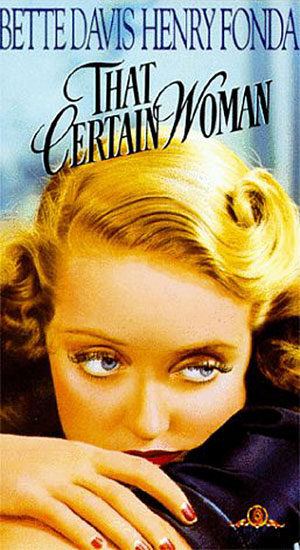
That Certain Woman (1937)


Behold, the absolute WORST Bette Davis movie I've ever seen (And as someone who has seen 36 or 37, I can't remember, Bette Davis movies, that's quite a statement). Seriously, this film has no idea what it wants to be and what story it wants to tell.

Bette Davis plays Mary Donnell, a secretary to attorney Lloyd Rogers (Ian Hunter) who is in love with her. Unfortunately for Mary, she has a secret. Though, it's not that secret because it's revealed at the beginning of the film. Mary used to be married to a bootlegger who was killed in the St. Valentine's Day Massacre. Since then, she's been a minor notorious figure in the news as a murdered mobster's wife so she changed her name and has taken her job as a secretary (which is where the film starts).

Mary is in love with the wealthy Jack Merrick Jr. (Henry Fonda) and they elope. However, since Mary is "common", Jack's father shows up and forces his pussy of a son to annul the marriage. Unfortunately, Mary is pregnant with his child, but decides to keep the baby and wait for him to return.

Suddenly, Mary's boss is sick and comes over to her house and dies, it's all quite sudden and the death puts Mary back into the spotlight as a notorious figure. Jack tracks her down, bringing his sickly wife in tow and proclaims that he will leave her for Mary, but Mary says no. Now knowing that Jack has a son, Jack's father tried to have marry declared an unfit mother and take the child from her. Since she knows that she cannot win, she gives the child up.

The last 5 minutes of this movie are so bizarre, and so odd that my head almost imploded. So, as Mary gives up the child, she tearfully tells her best friend to tell that child that she never existed, that he didn't have a mother. So, I feel sad, knowing that Mary is about to kill herself, because that's what the scene is suggesting.

WELL I WAS WRONG.

Mary instead takes off to some sort of exotic locale, wearing one of those huge hats that they wear in old movies and living it up, only to be told that Jack's wife had died and he wants her back. HAPPY ENDING.

Really, this movie is like three different Bette Davis films frankensteined together to form this cinematic abortion. Is it about her boss' unrequited love for her or her having to deal with being a single mother, or about her being famous, or about trying to get back with Jack? It can't seem to decide so it just throws them all together with glue and a prayer. Storylines pop up only to disappear minutes later and so on and so forth, it just feels so sloppy.

You don't care about any of the relationships because Mary's boss is too creepy and won't leave his wife, and Jack is just a wimp who left the woman he really loves because Daddy said too.

Bette Davis is watchable (as she always is) and interesting to watch, but she's surrounded by garbage, like a blind kid dancing in a burning house. It's kinda funny, but also kinda sad because you know the blind kid gets torched.

Don't watch this movie.