Showing posts with label Barbara Stanwyck. Show all posts

Monday, November 9, 2009

Sorry, Wrong Number (1948)


The brilliant Barbara Stanwyck elevates this pretty average thriller into something actually worth watching.

Alright, y'all, here it is, Sorry, Wrong Number. It stars Barbara Stanwyck (obviously) as Leona Stevenson, the invalid wife of Henry Stevenson (Burt Lancaster). One night, Leona is all alone, her husband is late so Leona tries to find out where he is. Her only means of communication is the telephone, so while waiting for her call to be connected to her husband's office, the wires are crossed and she overhears two men planning the murder of a woman. As the film progresses, we learn that Leona doesn't know quite as much about Henry as she thought, and that the murder being planned may be her own.

Now, that doesn't sound too bad, right? Well it's not, but the main problem with the film arises out of its narrative structure. You see, a great deal of the film consists of flashbacks, as Leona calls person after person hoping to find her husband and we get scenes of what someone observed about Henry the previous day or something like that. Also, we get the story of how Leona and Henry met, as well as the current state of their marriage. We learn that Leona stole Henry from a woman who loved him, and that Leona is a spoiled heiress to her father's prescription drug fortune, we also learn that Henry is frustrated with Leona, having to keep her happy to avoid upsetting her condition, which consists of a heart attack during times of stress.

The flashbacks are a nice way to flesh out the backstory of the film, but it takes away from the suspense, especially since most of the flashbacks concern themselves with the condition of the Stevenson marriage as opposed to the murder plot that Leona overhears, which seemed to be a higher storytelling priority, at least to me.

Luckily, we have Barbara Stanwyck in the lead. She delivers a wonderful performances, making Leona horrible and spoiled in the flashbacks, but adding levels of vulnerability and sorrow during the present, where the life she had constructed for herself falls down around her. She makes the character paranoia and fear totally real, which makes it easy to relate to her and to care about whether or not she survives the film.

Aside from that, the film is a solid thriller with a big hiccup in the story telling department due to the overabuse of flashbacks. But it features one of Barbara Stanwyck's best (and Oscar nominated) performances, which makes it watching simply for that.

Monday, August 3, 2009

The Lady Eve (1941)

Barbara Stanwyck is a tough cardsnipe who tries to take naive rich boy Hentry Fonda for a con, only to fall in love with him.

Barbara Stanwyck is Jean Harrington, a cardsnipe who travels from boat to boat with her father setting wealthy men up in card games to take them for all they're worth. So when Charlie Pike, son of a wealthy Ale maker boards their ship, Jean sets about romancing the poor fool and robbing him blind. unfortunately she falls in love with him, and to make matters worse, Charlie finds out what she is, lies and states that he was on to her the entire time and was only playing her for a sap and they part ways on the boat, leaving Jean broken-hearted and full of hate.

She plans to get her revenge, however, but showing up at Charlie's father's house as The lady Eve, winning Charlie over and then breaking his heart just like he broke hers. But, given that this is a romantic comedy, things don't necessarily work out that way.

Let's get this out of the way, Barbara Stanwyck is fantastic in this movie, especially when you consider that she's really only her "true" self a few times, and most of the time she's pretending to be someone else. She makes Jean tough, but still vulnerable, and she gives her an intelligence that makes her a believable card snipe and smart enough to realize that being in love with a man you've only known for a few days is pretty silly.

Henry Fonda is good as well. Making his character appear to be clumsy, naive and spoiled, but never to the point where he's unlikable. He has the task of making it appear believable that he could fall in love with the same woman twice, and it really works.

If there's any real fault with the film, it's that the comedy aspect of it is very light. I didn't find the film particularly humorous, but I still enjoyed the lightheartedness of it, as well as the script and the acting.

The film itself feels very brisk, despite being an hour and 40 minutes long, it seemed to fly by, which is great because it never seems to wear out its welcome.

While I wish the film would have been a bit funnier, the acting more than makes up for it, particularly on the part of Barbara Stanwyck. It may stretch your suspension of disbelief (though, the film plays on that by having on character constantly insist that Jean and Eve are the "same dame"), but it's a good film that's become a "must-see" when it comes to screwball comedies.

Saturday, July 25, 2009

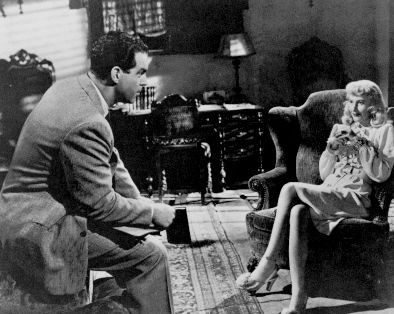
Double Indemnity (1944)

To make up for the last two entries, we have a full-blown noir classic. Nothing obscure about this film, which has rightfully earned its spot on any sort of "must-see" list.

Fred MacMurray is Walter Neff, a insurance salesmen who stumbles into his insurance office, suffering from some sort of injury. He gets a recording device and begins to confess to his part in a murder. The rest of the film is a flashback as Walter recounts the events that led him to this predicament.

It begins when he meets Phyllis Dietrichson (Barbara Stanwyck), the wife of a wealthy man who seduces him and together they create a plan to take out a double indemnity insurance policy on her husband (which pays double in the case of accidental death) and then murder him and make it look like an accident. The commit the crime, but Barton Keyes (Edward G. Robinson), Walter's friend and co-worker begins to unravel the case when it comes to him to investigate the insurance claim.

The acting in this film is superb, with MacMurray playing a bit of a cad who believes that he is truly in love with the woman who is clearly using him and he accurately portrays a man that is slowly being pulled into circumstances that are way over his head. Edward G. Robinson is very good too, playing an actual good guy for once. MacMurray and Robinson have great chemistry together as two close friends who begin to assume a cat-and-mouse dynamic.

But the standout is Barbara Stanwyck who plays Phyllis as a completely cold and frigid woman, totally ruthless when it comes to her husband and others around her. The scene where her husband is murdered is probably the best testament to her acting ability as the camera is focuses entirely on her face as Walter strangles her husband and we see several emotions play on her face: fear, excitement and eventual satisfaction.

The plot contains a lot of twists and turns, which is surprising since we have a general idea of how the film ends because of it's opening (Like another Billy Wilder film, Sunset Boulevard), but it's still able to keep you invested into what happens.

I know I can't really do a film like this justice in my own words, but this film really needs to be seen. It features one of the greatest performances of all time as well as being one of the best films of all-time. So please watch it.

Tuesday, May 19, 2009

Baby Face (1933)


Baby Face is probably the most sexually explicit film that I've seen when exploring older film. It features a lot of scenes that obviously lead to sex in addition to a lot of suggestion as to sexual activity. It's kinda crazy, and if I were a 40 year old woman in the 1930's, this movie would certainly make me cover my mouth in shock and horror.

Also, I should note that this entry is based on the uncut version of the film. There is a butchered censored version out there, but I have not seen it. Both are available in the Forbidden Hollywood collection from TCM.

Barbara Stanwyck plays Lily Powers, a waitress in her father's speakeasy. When she's not serving rowdy men, her father is pimping her out to city officials so that they will allow him to keep his illegal hooch house running. This changes one night when her father's still explodes, killing him. Encouraged by a Nietzsche-reading friend to use her sexuality to use men as opposed to allowing them to use her, she sets off to the city to make her living.

What follows is basically a string of sexual conquests within a corporation. She starts on one man, only to dump him when she meets his superior. This results in the ruining of a few lives, but Lily doesn't care, she's in it for the money, like any good whore should.

This changes when she meets Courtland Trenholm (Played by Bette Davis' leading man George Brent), the son of the owner of the business. He instantly takes a liking to her and they begin a relationship. However, is Lily using him for his money? Or has her steel-exterior cracked to allow her to feel love for a man?

This leads to the main flaw of the film, it's ending (which was added due to censor intervention). We have a general idea of Lily's goals and her personality, but the ending kind of throws that out to give us a happy ending that doesn't ring true to the tone of the rest of the film. People have died because of Lily and she didn't bat an eyelash, so for some of the events to occur that occur in the end just feels forced.

But the film should be watched alone for Barbara Stanwyck's performance. As demonstrated in Double Indemnity, she can play a great cold-hearted b*tch, and she plays Lily as a woman with laser focused intensity upon setting herself on easy street.

George Brent is charming, but as someone who has seen him in countless Bette Davis movies, he isn't the best actor in the world, and he has an awkwardness about him whenever he is on screen.

Really, this film deserved to be seen for the wonderful central performance from Barbara Stanwyck as well as its place as being one of the most controversial films of its day, plus it's a pretty good movie to boot.