Sunday, May 31, 2009

Kitty Foyle (1940)

Kitty Foyle, the story of a woman torn between two men as well as featuring Ginger Rogers playing the most unconvincing teenager ever put to film.

The film starts with Kitty (Ginger Rogers)'s doctor boyfriend Mark (James Craig) proposing, upon which she returns to her hotel room only to find her former flame, the wealthy Wyn Strafford (Dennis Morgan) waiting for her, hoping to resume their relationship (despite Wyn being married and refusing to divorce). Kitty says yes and packs her bags to leave with Wyn, when her demonic mirror (Well, her reflection) begins talking to her, forcing her to look back at what led her to this point. Basically, the film follows Kitty's on-and-off again relationship with Wyn (who looks like he's had a stroke whenever he moves his mouth).

It must be said that Ginger Rogers is very good in the title role, for which she actually won the Oscar (though, try watching Bette Davis in The Letter and agreeing with that choice), she gives Kitty a vulnerability as well as a fighting spirit, which makes it a pity that we almost never see her without a man. I'm not trying to scream sexism or anything, but Kitty is always alternating between Wyn and Mark, which kind of undoes that film's efforts to portray Kitty as this strong independent woman.

That's where the positives of this film ends. It's not a horrible film by any means, but both men are such bores that I personally didn't care who she stuck with. Wyn is an overly-charming and spoiled playboy (and it doesn't read well for him that he is willing to abandon his wife and child at the drop of a hat) and Mark is creepy (he negotiates a date out of Kitty by threatening to inject her with a syringe and once they have the date he insist on playing double solitaire for 3 hours as some sort of "test").

Plus, the fact that the film is essentially a flashback really hurts any sort of suspense about the film. We know that Kitty and Mark end up together and that Wyn marries another woman, there's also a major plot development that fails to illicit any sort of interest because we already know how it is going to work out. Not to mention that the flashbacks don't really offer any real insight that would make Kitty make the decision that she does at the end of the film.

I know it sounds like I hated this film, because I didn't. Ginger Rogers is good enough to recommend this film alone, but without her the film is a big soap opera. There are interesting moments, but there's too much of "Wyn is here and I am in love!" to "Wyn is gone, and I am sad. I guess I'll play with the affections of this creepy-ass doctor for a while". The film really could have been trimmed a bit, but it's still a decent enough film.

Wednesday, May 27, 2009

Mourning Become Electra (1947)

Incest, Murder and Suicide! That pretty much sums up Mourning Become Electra, one of the most messed up movies I've ever seen.

The film stars the way-too-old-for-this-part Rosalind Russell as Lavinia Mannon, the daughter of the wealthy Ezra Mannon (Raymond Massey). She is completely devoted to her father (freakishly so), so she becomes quite upset when her mother Christine (Katina Paxinou) poisons him so that she may leave to be with her much younger lover. Enraged, Lavinia teams up with her Oedipus complex-ridden brother Orin (Michael Redgrave) to kill Christine's lover. The resulting break in the family could potential damage Lavinia's relationship with her love Peter (Kirk Douglas) as well as drive her mother and brother to extremes.

Ok, I want to get this out of the way, this is not going to be a film that is easy to recommend. I happen to love it, but it's VERY long (173 minutes) and the acting could turn some people off due to appearing overly theatrical. Rosalind Russell is absolutely fantastic as the conniving Lavinia who seeks to avenge her father's murder and Michael Redgrave is just as good playing her brother Orin who could be torn apart by aiding his sister in her revenge.

The film has a very heavy suggestion of incest. Not necessarily of the actual act, but of inappropriate relationships between parent and child. In fact, Orin is not out to avenge is murdered father, he instead wants to have his mother all for himself again. It can make for a very uncomfortable viewing experience. There's also a lot of weird mysticism in the film, with the presence of long-deceased Mannons in their family estate become more and more prevalent as the film goes on and the sins stack up.

This is not going to be a film for everyone, the acting can be seen as over-the-top and as I already said, the film is VERY, VERY long, but if it you still wish to give the film a show, you'll find a very layered, very tragic film.

Tuesday, May 26, 2009

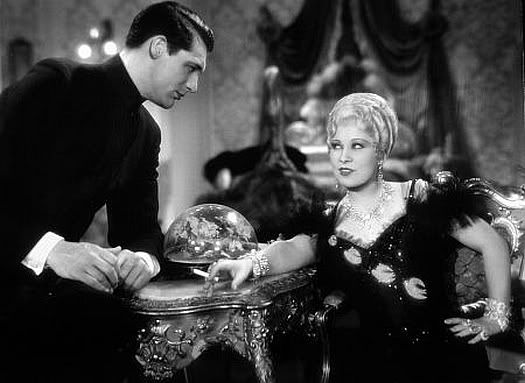
She Done Him Wrong (1933)


I can't believe that I've been doing this blog for a while (and by a while I mean a week or two, with as far as I know, no readers) and I've yet to write up a Mae West movie. Shame on me.

Mae West's movie are essentially male harem movies, there's minimal plot and it basically involves Mae West cavorting around with several different men. But that's not really a knock to the movie, because Mae West may be one of the greatest entertainers ever, despite not being a very good actress or singer. She just embodied this character of a wise-cracking, seen-it-all, man eater, as well as writing a great deal of her films and stage plays. The actual plot of She Done Him Wrong revolves around Lady Lou (Mae West) who is a nightclub entertainer who used to date a dangerous criminal who is now in prison. She promised to remain faithful to him, and being Mae West, she didn't. So he's out to get her. In addition to this, she has to deal with shady goings on in her night club as well as the local missionary Captain Cummings (Cary Grant).

The great thing about this film is that it knows what it is, it's a breezy, fun film about Mae West using man after man, and it doesn't wear out it's welcome, since it's only around 66 minutes (the shortest film ever nominated for Best Picture). It's filled with Mae West's double entendres and sexual suggestion. The plot is a bit ridiculous, involving the already mention vengeful lover as well as some sort of white slavery ring, but it doesn't bog itself down in such details, instead focusing on Mae West walking around and being fabulous.

I know I haven't said much in terms of substance about the film, probably because the film itself is light on substance, which is probably why its such a fun movie, one that should definitely be checked out. And even if you don't like it, it's only 66 minutes.

Saturday, May 23, 2009

Bordertown (1935)


Bordertown is one one of the few older films I've seen that actually deals with issues with the Mexican-American community, however, the film's progressive views quickly lose their power due to an incredibly racist ending, as we shall soon see.

Bordertown stars Paul Muni as Johnny Ramirez, a Mexican American who recently graduated from law school. However, he quickly loses his license during his first case involving a socialite (Margaret Lindsay) who runs into a local man's car and totals it. Johnny is unprepared and quickly loses his case, and when Dale, the socialite offers to pay for the car, her boyfriend (who is also her lawyer) does not allow her and insults Johnny, causing Johnny to strike him, leading to his disbarment.

Embarrassed and determined to make some real money, he ends up as a bouncer in a night club run by Charlie Roark (Eugene Pallette), the two become friends and Charlie quickly realizes that he can use Johnny's intellect to his gain and uses Johnny as an adviser of sorts.

This all ends when Marie Roark (Bette Davis) enters the picture. One look at Johnny and she wants some red hot Latino Lovin so much so that she kills her husband and makes it look like an accident. Inheriting her husband's money, she and Johnny become partners in building a better, classier night club, at the opening of this night club, Johnny meets Dale and falls in love with her, which upsets Marie greatly.

The plot of the film is a bit iffy in its pacing, as what would usually be several major plot points are gone through very quickly and without much fanfare, such as the investigation in Charlie's death, or Marie's descent into insanity.

On that point, it brings me to the biggest issue with the film, the character of Marie Roark. I have no idea why she suddenly become to possessive of Johhny, the film really doesn't give any reason at all. We know she dislikes her husband, but Johnny didn't really show an interest in her, so I don't understand her killing her husband and then her sudden insanity. I guess you could argue that she is haunted by her crime, or you could even say that she's faking it, but regardless, the film moves her from possessive to out and out batsh*t crazy that it's baffling. It's not really the fault of Bette Davis, because the character is written that way, and it allows for Bette Davis to give a very over-the-top, neurotic (always clutching her hair or biting her fingernails) performance, but the character's motivation are far too murky.

Paul Muni is good as well, he plays a Mexican American without getting into offensive stereotype, but the character is fairly shallow. He's a decent guy out to make some money, other than that, there isn't much personality to his character.

And this brings me to the racism of the film. At first, it gives well-rounded portrayals of Mexican Americans are kind, but simple and poor, and it shows that Johnny meets a lot of prejudice because of his ethnicity, but (SPOILER ALERT) the film ends on such a horrible note where Johnny forsakes the life he has made for himself and returns to "his people", which according to him, is where he belongs after losing Dale due to his ethnicity. I suppose you could make the argument that he feels defeated and it's shown more as a tragedy that his character takes that view, and that the film itself isn't trying to say that about the Mexican community, but I'm not sure if I really buy it (END SPOILER ALERT)


Overall, it's hard to recommend this movie, because of the issues I mentioned. It's not offensively bad, but it's not terribly good either. If you like Bette Davis or Paul Muni or are interested in the portrayal of Mexican Americans, then maybe it's worth a look, but the uneven pacing, odd character development, and racist overtones take this film away from being truly good.

Friday, May 22, 2009

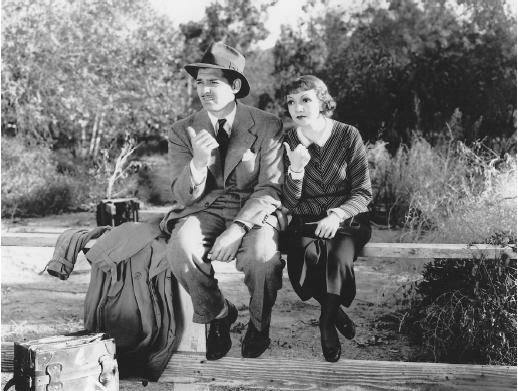
It Happened One Night (1934)

The first film to win the Oscar grand slam (Actor, Actress, Director, Picture, and Screenplay), It Happened One Night is probably one of the more recognizable films that I've chosen to blog about, so if you've never heard of some of my choices, I hope you've heard of this one.

Anyway, if you read my entry on The Bride Came C.O.D. you know that that film is essentially a rip-off of this film, so the plots are very similar. Claudette Colbert plays Ellen "Ellie" Andrews, a pampered socialite who marries a fortune-hunter. But before the two can consummate the marriage, her father whisks her away onto the family yacht to keep her away from her beloved. Well, Ellie will have none of that, so she dives off the boat and swims to shore. Once on land, she decides to take buses to New York, since her father will most likely be able to find her if she tried an airport. On the way, she meets down-on-his-luck reporter Peter Warne (Clark Gable). He instantly recognizes her, and they make a deal. He will help her get to New York if she will give him exclusive rights to her story, otherwise he will call her father and collect the reward. She agrees and the two set out on a road trip to New York, bickering along the way, and of course, falling in love.

The story is fairly predictable, it follows the expected trajectory of any other film of its kind, but as you probably expect, it doesn't really matter. The acting is on such a high level and the script is so sharp that you're fully willing to commit to the ride.

Clark Cable is incredibly charming and he plays his frustrations with Ellie to great effect. Throughout the film he is trying to teach her things, how to dunk a donut, or how to hitchhike and is consistently amazed at how sheltered and spoiled she is. But he plays to perfection, never become mean or overbearing. Claudette Colbert is equally as good, playing a character that has to be both tough, vulnerable, and naive, and she makes it entirely believable. Ellie will not put up with crap from anyone, but she's just afraid enough of traveling on her own that she'll accept help from Peter, despite not wanting to.

The romance itself is handled very well, because it doesn't come about as sudden proclamations of love, instead the two become more and more comfortable around each other, working well together and eventually realizing that they do have feelings for each other. But they are both aware of how sudden and unlikely it is, which adds to be naturalness and believability of the situation. In fact, Peter at one point talks about how he's crazy to be in love with her.

This really is a movie that deserves to be seen, because it's such a great film as well as having an place in film history as one of the best romantic comedies of all time and some argue that it invented the "Screwball" comedy genre. So watch it, please.

Wednesday, May 20, 2009

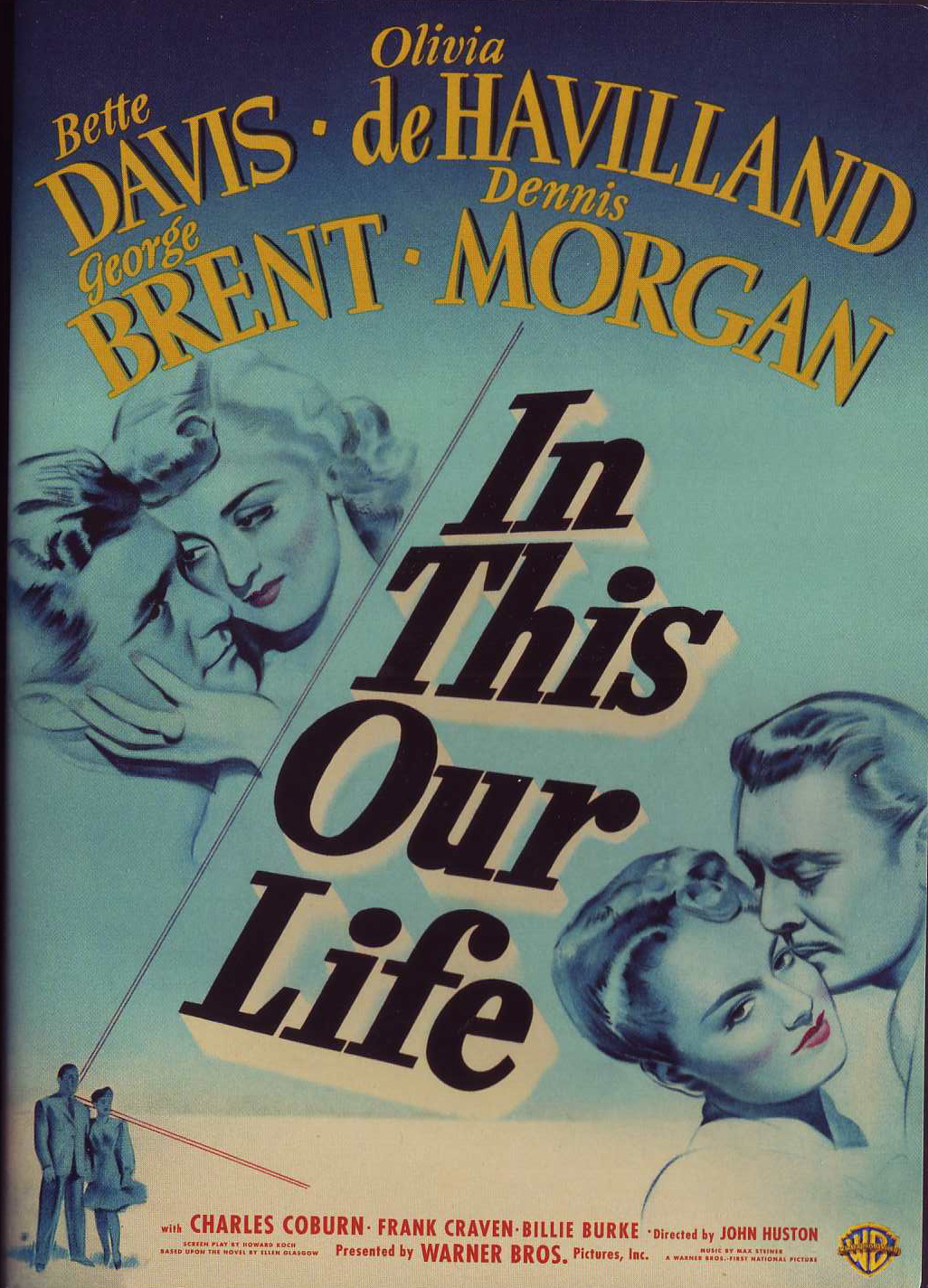
In This Our Life (1942)


This is easily one of the soapiest films that Bette Davis ever made, which is really saying something if you know anything about Bette Davis movies.

The film stars Bette Davis and Olivia de Havilland as the unfortunately named sisters Stanley and Roy Timberlake. And the plot goes as follows (Be sure to pay attention, it can be quite confusing). Stanley is engaged to lawyer Craig Fleming (George Brent), but she decides to steal Roy's husband Peter Kingsmill (Dennis Morgan) and run off. While they are gone, Roy and Craig fall in love. Stanley is so horrible that she drives Peter to commit suicide, so she returns home and plans on stealing Craig, her former beau away from her sister, who is his current beau. If read as is, it sounds like a tangled gay drama.

There is also a plot involving Stanley having a hit and run accident that kills a woman, and instead of fessing up to it, she blames the local black man who is studying to become a doctor or something, but since he's black they arrest him anyway. Of course, Stanley's story comes unraveled and she turns into a neurotic mess and ends up in a high speed chase with the cops.

Really, if you like your movies campy and soapy, then this in the film for you. Bette Davis gets to be nasty, mean, and selfish as well as over-the-top and neurotic while Olivia de Havilland gets to be sweet, virginal and innocent.

There really isn't much left to say about this movie, it's certainly not one of Bette Davis' best movies, but it's far from her worst. The acting is good enough to keep you entertained and the story is a big melodrama, which can be said for a lot of Bette Davis' films. If you're in the mood for something a bit trashy, then give this movies a watch.

Tuesday, May 19, 2009

Baby Face (1933)


Baby Face is probably the most sexually explicit film that I've seen when exploring older film. It features a lot of scenes that obviously lead to sex in addition to a lot of suggestion as to sexual activity. It's kinda crazy, and if I were a 40 year old woman in the 1930's, this movie would certainly make me cover my mouth in shock and horror.

Also, I should note that this entry is based on the uncut version of the film. There is a butchered censored version out there, but I have not seen it. Both are available in the Forbidden Hollywood collection from TCM.

Barbara Stanwyck plays Lily Powers, a waitress in her father's speakeasy. When she's not serving rowdy men, her father is pimping her out to city officials so that they will allow him to keep his illegal hooch house running. This changes one night when her father's still explodes, killing him. Encouraged by a Nietzsche-reading friend to use her sexuality to use men as opposed to allowing them to use her, she sets off to the city to make her living.

What follows is basically a string of sexual conquests within a corporation. She starts on one man, only to dump him when she meets his superior. This results in the ruining of a few lives, but Lily doesn't care, she's in it for the money, like any good whore should.

This changes when she meets Courtland Trenholm (Played by Bette Davis' leading man George Brent), the son of the owner of the business. He instantly takes a liking to her and they begin a relationship. However, is Lily using him for his money? Or has her steel-exterior cracked to allow her to feel love for a man?

This leads to the main flaw of the film, it's ending (which was added due to censor intervention). We have a general idea of Lily's goals and her personality, but the ending kind of throws that out to give us a happy ending that doesn't ring true to the tone of the rest of the film. People have died because of Lily and she didn't bat an eyelash, so for some of the events to occur that occur in the end just feels forced.

But the film should be watched alone for Barbara Stanwyck's performance. As demonstrated in Double Indemnity, she can play a great cold-hearted b*tch, and she plays Lily as a woman with laser focused intensity upon setting herself on easy street.

George Brent is charming, but as someone who has seen him in countless Bette Davis movies, he isn't the best actor in the world, and he has an awkwardness about him whenever he is on screen.

Really, this film deserved to be seen for the wonderful central performance from Barbara Stanwyck as well as its place as being one of the most controversial films of its day, plus it's a pretty good movie to boot.